 Airworthy Prep
Part 107 practice test: 25 free questions with answers
A free Part 107 practice test for the FAA Remote Pilot knowledge test. Every question below is original, written from the FAA's own publications, and comes with the answer, an explanation, why the other options are wrong, the FAA source and the ACS code your score report would show.
Updated for the October 26, 2026 test change. From that date the FAA test shows chart images taken from current sectional charts, not just the old printed supplement. The chart questions here use extracts from the current FAA sectional.
The real test: 60 questions, 2 hours, 70% to pass, three answer choices each. These 25questions are spread across the 5 test areas in about the same proportions.
I. Regulations
48% of the real test, about 29 of the 60 questions.
Question 1UA.I.B.K21b
You are hired to inspect a radio tower that is 600 feet AGL. While you stay within a 400-foot radius of the tower, what is the highest altitude you may fly?
- A400 feet AGL
- B600 feet AGL
- C1,000 feet AGL
Show the answer and explanationHide the answer
Answer: C. 1,000 feet AGL
The normal limit is 400 feet AGL, but there is an exception for structures. Within a 400-foot radius of a structure, you may fly up to 400 feet above the structure's highest point. 600 + 400 = 1,000 feet AGL. If you move more than 400 feet away from the tower, the normal 400-foot limit applies again.
Why the others are wrong
- A: 400 feet AGL is the general limit, but it ignores the structure exception.
- B: 600 feet is the height of the tower itself. The rule allows a further 400 feet above it.
FAA source
- 14 CFR 107.51(b)(1)-(2)
Question 2UA.I.A.K4
Which of these events must the remote pilot in command report to the FAA within 10 calendar days?
- AThe drone is destroyed after hitting a tree in an empty field. Nothing else is damaged and nobody is hurt.
- BThe drone hits a garden fence. The repair, including materials and labor, will cost $650.
- CThe drone clips a parked car. The repair, including materials and labor, will cost $350.
Show the answer and explanationHide the answer
Answer: B. The drone hits a garden fence. The repair, including materials and labor, will cost $650.
You must report any operation that causes serious injury or loss of consciousness, or damage to property other than the drone itself, unless the repair cost (materials and labor) is $500 or less, or the property is a total loss worth $500 or less. The fence repair is $650, so it must be reported within 10 calendar days.
Why the others are wrong
- A: Damage to the small unmanned aircraft itself never counts toward the reporting threshold.
- C: The repair cost is $500 or less, so no report is required.
FAA source
- 14 CFR 107.9(a)-(b)
Question 3UA.I.C.K4
You passed your initial Part 107 knowledge test on 15 March 2025 and have done no training since. Until what date may you act as remote pilot in command?
- A15 March 2027
- B31 March 2027
- CThere is no expiry once the certificate is issued.
Show the answer and explanationHide the answer
Answer: B. 31 March 2027
To exercise remote pilot privileges, you must have passed the initial test or completed recurrent training within the previous 24 calendar months. A calendar month runs to the end of the month, so a test passed in March 2025 keeps you current through 31 March 2027. The certificate itself does not expire, but you cannot use it after that date until you complete recurrent training.
Why the others are wrong
- A: This counts 24 months to the day. The rule uses calendar months, which run to the end of the month.
- C: The certificate does not expire, but the knowledge recency requirement still applies.
FAA source
- 14 CFR 107.65(a)-(b)
- AC 107-2A, para 6.7.2 (p. 6-5) and Figure 6-1 (p. 6-6): recurrent training cycle examples
Question 4UA.I.E.K3a
Your drone weighs 249 grams (under 0.55 pounds) with everything attached, and its propellers are standard, unguarded blades. Can you fly it over people who are not participating in the operation under Category 1?
- AYes, because it weighs 0.55 pounds or less.
- BNo, because Category 1 also requires no exposed rotating parts that would lacerate human skin.
- CYes, as long as it is broadcasting Remote ID.
Show the answer and explanationHide the answer
Answer: B. No, because Category 1 also requires no exposed rotating parts that would lacerate human skin.
Category 1 has two aircraft requirements, and both must be met. The aircraft must weigh 0.55 pounds or less on takeoff and throughout the flight, including everything on board or attached, AND it must have no exposed rotating parts that would lacerate human skin on impact. Unguarded propellers fail the second test. Note that adding prop guards adds weight, which could push the aircraft over 0.55 pounds.
Why the others are wrong
- A: Weight is only one of the two Category 1 requirements.
- C: Remote ID is an additional requirement for sustained flight over open-air assemblies. It does not replace the aircraft requirements.
FAA source
- 14 CFR 107.110(a)(1)-(2) and (b)
Question 5UA.I.B.K25
You are qualified for night operations. What lighting must your drone have when flying at night?
- ALighted anti-collision lighting visible for at least 3 statute miles, with a flash rate sufficient to avoid a collision. You may reduce its intensity if that is in the interest of safety, but not turn it off.
- BLighted anti-collision lighting visible for at least 1 statute mile.
- CLighted anti-collision lighting visible for at least 3 statute miles, which you may switch off near people to avoid dazzling them.
Show the answer and explanationHide the answer
Answer: A. Lighted anti-collision lighting visible for at least 3 statute miles, with a flash rate sufficient to avoid a collision. You may reduce its intensity if that is in the interest of safety, but not turn it off.
Night operations need lighted anti-collision lighting visible for at least 3 statute miles, with a flash rate sufficient to avoid a collision. If operating conditions make it safer, you may reduce the intensity, but you may never extinguish it. The same lighting is required during civil twilight.
Why the others are wrong
- B: The required visibility is 3 statute miles, not 1.
- C: The rule allows you to reduce the intensity, never to switch the lights off.
FAA source
- 14 CFR 107.29(a)(2) and (b)
Question 6UA.I.B.K24
You are flying in Ohio. Official sunset is 18:42 local time. Your drone has no anti-collision lighting. What is the latest time you may fly?
- A18:42
- B19:12
- C19:42
Show the answer and explanationHide the answer
Answer: A. 18:42
Outside Alaska, evening civil twilight runs from official sunset to 30 minutes after sunset. Any flight during civil twilight, or at night, requires anti-collision lighting visible for 3 statute miles. Without lighting, you must finish flying by sunset, 18:42.
Why the others are wrong
- B: 18:42 to 19:12 is civil twilight, which still requires anti-collision lighting.
- C: After 19:12 it is night, which also requires the lighting.
FAA source
- 14 CFR 107.29(b)-(c)
Question 7UA.I.B.K10
Your visual observer (VO) suggests using binoculars to keep the drone in sight as it flies farther away. Which statement is correct?
- AThis is fine. Binoculars count as maintaining visual line of sight.
- BVisual line of sight must be kept with unaided vision (glasses or contact lenses allowed). Binoculars may be used only momentarily, for example to check for other aircraft.
- CThis is fine as long as the remote pilot is also watching a first-person-view (FPV) video feed.
Show the answer and explanationHide the answer
Answer: B. Visual line of sight must be kept with unaided vision (glasses or contact lenses allowed). Binoculars may be used only momentarily, for example to check for other aircraft.
Visual line of sight must be kept with vision unaided by any device other than corrective lenses. The FAA says aids such as binoculars may be used only momentarily to improve situational awareness, for example to avoid flying over people or conflicting with other aircraft. FPV video does not satisfy visual line of sight. The VO and remote pilot must also maintain effective communication throughout.
Why the others are wrong
- A: Continuous use of binoculars does not satisfy visual line of sight.
- C: FPV devices may be used, but they do not count as visual line of sight.
FAA source
- 14 CFR 107.31(a)
- 14 CFR 107.33
- AC 107-2A, para 5.9.1, p. 5-6: unaided vision
Question 8UA.I.B.K14
While you survey a field, a crop-dusting airplane begins low passes at the far side of it. What does Part 107 require you to do?
- AYield the right of way, and do not pass over, under or ahead of the airplane unless well clear.
- BHold your position. Below 400 feet AGL the airplane must avoid you.
- CClimb above the airplane's altitude so it can pass beneath you.
Show the answer and explanationHide the answer
Answer: A. Yield the right of way, and do not pass over, under or ahead of the airplane unless well clear.
A small unmanned aircraft must yield the right of way to all aircraft. Yielding means giving way and not passing over, under or ahead of the other aircraft unless well clear. You also may not fly so close to another aircraft that you create a collision hazard. Landing or moving well away is usually the safest choice.
Why the others are wrong
- B: Drones have no right of way over manned aircraft at any altitude.
- C: Passing over the airplane while not well clear is exactly what the rule forbids.
FAA source
- 14 CFR 107.37(a)-(b)
Question 9UA.I.A.K1
Which of these operations is outside the scope of 14 CFR part 107?
- AA surveyor flying a 30-pound drone over a client's farm
- BA roofer flying a 0.5-pound drone for paid roof photos
- CA news crew lifting a camera on a moored (tethered) balloon
Show the answer and explanationHide the answer
Answer: C. A news crew lifting a camera on a moored (tethered) balloon
FAA guidance lists the operations part 107 does not apply to, including moored balloons, unmanned free balloons, kites, amateur rockets, public aircraft operations, air carrier operations and limited recreational flying under 49 U.S.C. 44809. Both drone jobs are civil small unmanned aircraft operations under 55 pounds, so part 107 applies to them whatever the drone's size.
Why the others are wrong
- A: 30 pounds is under the 55-pound limit, so a paid survey flight with it is a part 107 operation.
- B: A drone of 0.55 pounds or less flown for a business is still a civil small unmanned aircraft operation, so part 107 applies.
FAA source
- AC 107-2A, para 4.1 (p. 4-1)
- 14 CFR 107.1
Question 10UA.I.A.K1
You fly a drone strictly for fun under the recreational exception (49 U.S.C. 44809), following a community-based organization's safety guidelines. A neighbor offers you $50 to photograph his roof for an insurance claim. How must that flight be conducted?
- AUnder part 107, because the flight is no longer strictly recreational
- BUnder the recreational exception, if you follow the CBO guidelines
- CUnder the recreational exception, because the fee is under $100
Show the answer and explanationHide the answer
Answer: A. Under part 107, because the flight is no longer strictly recreational
Part 107 does not apply to limited recreational flying under 49 U.S.C. 44809, but that exception requires the aircraft to be flown strictly for recreational purposes. A paid photo job is not recreational, so it must be flown under part 107, by a certificated remote pilot with a registered aircraft.
Why the others are wrong
- B: Following CBO guidelines is only one condition of the exception; the flight must also be strictly recreational.
- C: There is no dollar threshold: any flight that is not strictly recreational falls outside the exception.
FAA source
- 14 CFR 107.1(b)(2)
- AC 107-2A, para 4.1 and footnote 1 (p. 4-1)
Question 11UA.I.A.K2
Your heavy-lift drone weighs 49 pounds. For a client job you attach a 7-pound camera and gimbal. Ready for takeoff, how does part 107 treat this aircraft?
- AIt is a small unmanned aircraft, since removable payloads do not count
- BIt is a small unmanned aircraft, since the airframe is under 55 pounds
- CIt is not a small unmanned aircraft, so part 107 does not cover it
Show the answer and explanationHide the answer
Answer: C. It is not a small unmanned aircraft, so part 107 does not cover it
A small unmanned aircraft is one weighing less than 55 pounds on takeoff, including everything on board or otherwise attached. 49 + 7 = 56 pounds, so this aircraft does not meet the definition and cannot be flown under part 107 in this configuration. Getting the takeoff weight below 55 pounds would bring it back within the rule.
Why the others are wrong
- A: Payloads count whether or not they are removable: the definition includes everything attached at takeoff.
- B: The limit is for the whole aircraft at takeoff, including everything attached, not the airframe alone.
FAA source
- 14 CFR 107.3 (definition of small unmanned aircraft)
- AC 107-2A, para 4.2.8 (p. 4-2)
Question 12UA.I.A.K2
You plan to bring a visual observer (VO) to a job. Under the part 107 definition, what is a visual observer?
- AA certificated remote pilot at the site who stands ready to take over the controls
- BA person you designate to help the crew see and avoid air traffic and other objects
- CA person with a radio who passes air traffic control instructions to the remote pilot
Show the answer and explanationHide the answer
Answer: B. A person you designate to help the crew see and avoid air traffic and other objects
Part 107 defines a visual observer as a person designated by the remote pilot in command to assist the remote pilot in command and the person manipulating the flight controls to see and avoid other air traffic or objects aloft or on the ground. The role is about watching for hazards, not flying the aircraft or handling radio calls.
Why the others are wrong
- A: Being ready to take over the controls describes another remote pilot, not the VO role in the definition.
- C: Relaying ATC instructions is not part of the definition; a VO helps the crew see and avoid traffic and objects.
FAA source
- 14 CFR 107.3 (definition of visual observer)
- AC 107-2A, para 4.2.11 (p. 4-2)
II. Airspace Classification and Operating Requirements
20% of the real test, about 12 of the 60 questions.
Question 13UA.II.A.K1d
Refer to the chart extract. You want to fly at 200 feet AGL directly over Bowerman Field (HQM). What airspace is this, and what do you need?
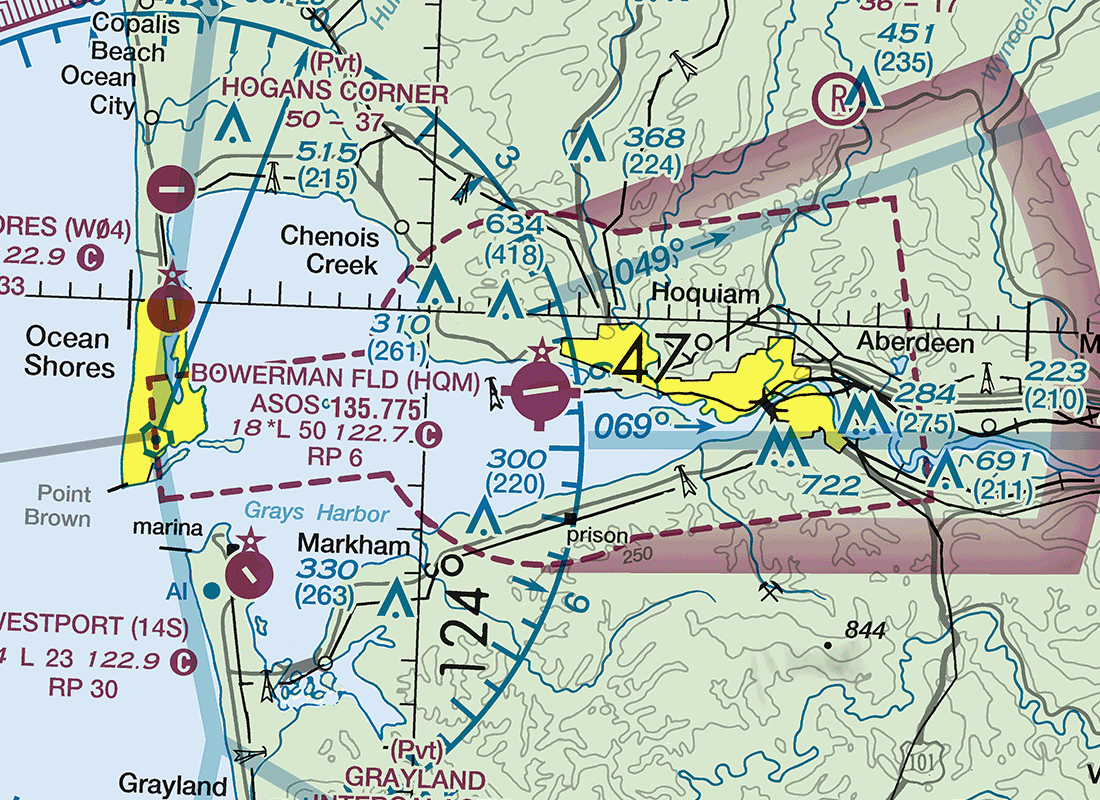
Seattle Sectional, 29 Oct 2026 to 24 Dec 2026 (FAA). Extract, not for navigation. - AClass G airspace. No ATC authorization is needed.
- BClass E airspace that starts at the surface. Prior ATC authorization is required.
- CClass D airspace. Prior ATC authorization is required.
Show the answer and explanationHide the answer
Answer: B. Class E airspace that starts at the surface. Prior ATC authorization is required.
The magenta dashed line around Bowerman Field marks a Class E surface area: controlled airspace that starts at the ground. Part 107 requires prior ATC authorization to fly within the lateral boundaries of a Class E surface area designated for an airport, just as it does for Class B, C and D.
Why the others are wrong
- A: Class G would have no magenta dashed line. The dashed line means controlled airspace starts at the surface.
- C: Class D is shown with a blue dashed line, and HQM has no control tower frequency (CT).
FAA source
- FAA Aeronautical Chart Users' Guide (9 Jul 2026), p. 17: Class E surface airspace symbol
- FAA Aeronautical Chart Users' Guide (9 Jul 2026), p. 16: Class D symbol
- 14 CFR 107.41
Question 14UA.II.A.K1a
A client's warehouse is 3 nautical miles from a major airline hub, inside the surface area of its Class B airspace. You plan to fly at 150 feet AGL. What does part 107 require before you fly?
- ATwo-way radio contact with approach control before takeoff
- BPrior authorization from ATC to fly in the Class B airspace
- CNothing extra, since you will stay below 400 feet AGL
Show the answer and explanationHide the answer
Answer: B. Prior authorization from ATC to fly in the Class B airspace
Class B surrounds the nation's busiest airports and generally runs from the surface to 10,000 feet MSL. Part 107 says no one may fly a small unmanned aircraft in Class B, C or D airspace, or in a Class E surface area for an airport, without prior authorization from air traffic control. Staying low does not take you out of airspace that starts at the surface.
Why the others are wrong
- A: Radio contact before entry is a rule for manned aircraft. Part 107 requires prior ATC authorization instead.
- C: The 400-foot limit does not change the airspace. The Class B surface area starts at the ground, so you are inside it.
FAA source
- 14 CFR 107.41
- PHAK (FAA-H-8083-25C), p. 15-2
- Remote Pilot Study Guide (FAA-G-8082-22), p. 5
Question 15UA.II.A.K1e
Refer to the chart extract. You plan to fly at 300 feet AGL over the fairgrounds just east of Chehalis-Centralia airport (CLS), inside the shaded magenta ring. What airspace will you be in?
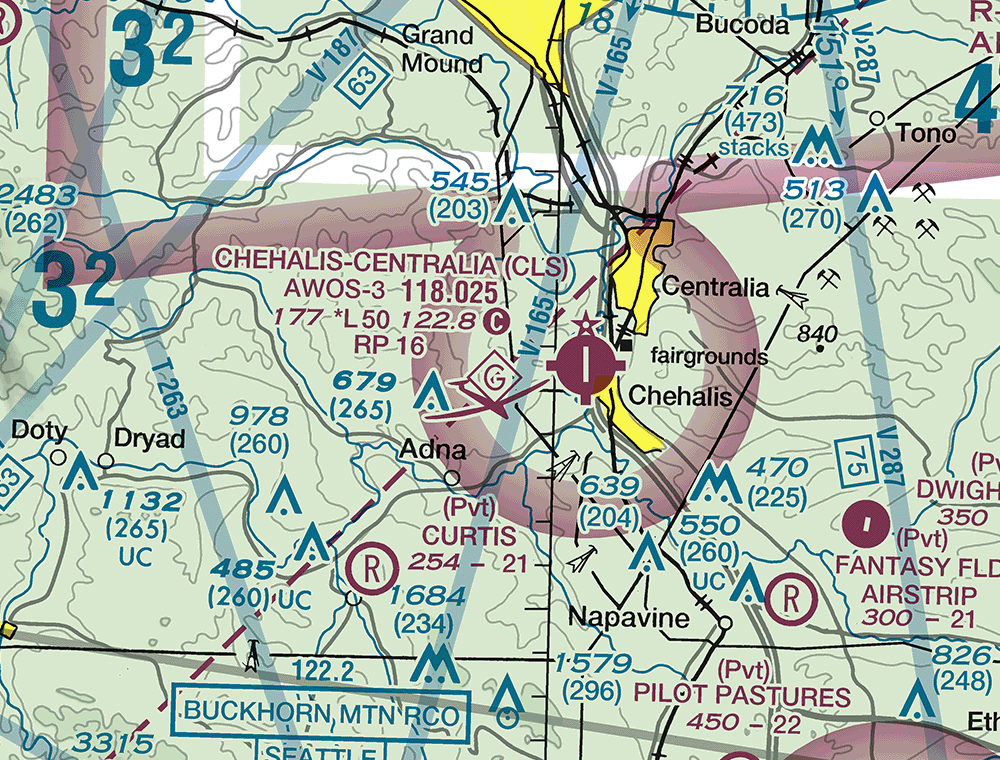
Seattle Sectional, 29 Oct 2026 to 24 Dec 2026 (FAA). Extract, not for navigation. - AClass G. No ATC authorization is required, but you must not interfere with airport traffic.
- BClass E from the surface. Prior ATC authorization is required.
- CClass D. Prior ATC authorization is required.
Show the answer and explanationHide the answer
Answer: A. Class G. No ATC authorization is required, but you must not interfere with airport traffic.
The shaded magenta band (a vignette) means the floor of Class E airspace is 700 feet AGL on the shaded side. Below 700 feet AGL inside the ring, the airspace is Class G, so no ATC authorization is needed at 300 feet. You are still right beside a runway, so Part 107 requires you not to interfere with the airport's traffic pattern. Monitoring the CTAF (122.8) is good practice.
Why the others are wrong
- B: A Class E surface area would be marked with a magenta dashed line. CLS has none.
- C: Class D is shown with a blue dashed line and the airport would show a control tower frequency.
FAA source
- FAA Aeronautical Chart Users' Guide (9 Jul 2026), p. 17: magenta vignette, controlled airspace floor 700 ft AGL
- 14 CFR 107.41
- 14 CFR 107.43
Question 16UA.II.A.K2
Refer to the chart extract. A client wants footage from inside the areas labelled R-6703A to R-6703E, east of Olympia. What is required before you fly there?
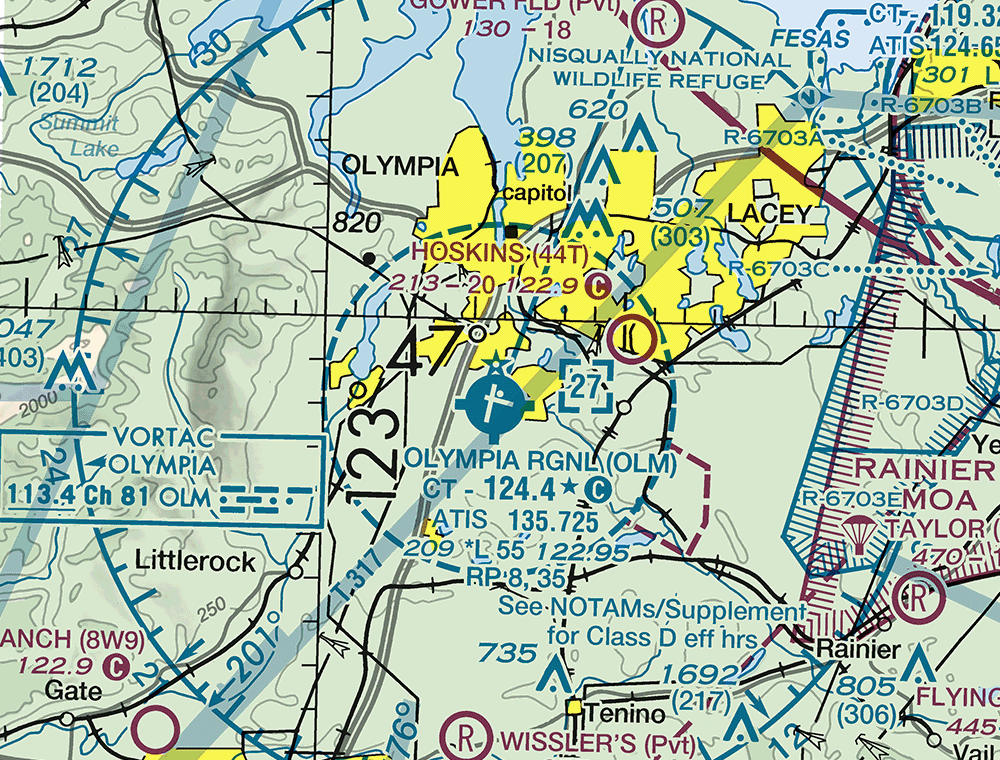
Seattle Sectional, 29 Oct 2026 to 24 Dec 2026 (FAA). Extract, not for navigation. - APermission from the area's using or controlling agency.
- BNothing, as long as you stay below 400 feet AGL.
- CNothing. It is a military operations area, so you only need to watch for military traffic.
Show the answer and explanationHide the answer
Answer: A. Permission from the area's using or controlling agency.
The R prefix and hatched border mark a restricted area, a type of special use airspace containing unusual, often invisible hazards such as artillery firing, aerial gunnery or guided missiles. Part 107 prohibits flying in a restricted area without permission from the using or controlling agency.
Why the others are wrong
- B: The restricted area rule has no altitude exemption for drones. Staying low does not remove the hazard or the need for permission.
- C: MOAs are labelled with a name and 'MOA' (for example, the Rainier MOA on this extract). R-6703 is a restricted area, which needs permission.
FAA source
- 14 CFR 107.45
- Pilot's Handbook of Aeronautical Knowledge, FAA-H-8083-25C, ch. 15, p. 15-3: Restricted Areas
Question 17UA.II.A.K1a
Which description fits a typical Class B airspace area?
- ASurface to 4,000 feet above the airport, with a 5 NM core and 10 NM shelf
- BSurface to 2,500 feet above the airport, around any towered airport
- CSurface to 10,000 feet MSL, in layers like an upside-down wedding cake
Show the answer and explanationHide the answer
Answer: C. Surface to 10,000 feet MSL, in layers like an upside-down wedding cake
Class B is generally airspace from the surface to 10,000 feet MSL around the busiest airports. Each one is individually tailored, with a surface area and two or more layers, so many look like an upside-down wedding cake.
Why the others are wrong
- A: This is the usual shape of Class C airspace, not Class B.
- B: This describes Class D airspace around an airport with an operating control tower.
FAA source
- PHAK (FAA-H-8083-25C), p. 15-2
- Remote Pilot Study Guide (FAA-G-8082-22), pp. 5-6
Want to try it against the clock?
The free mock gives you 10 questions in the real test format, scored by test area. No signup.
Take the free mockIII. Weather
5% of the real test, about 3 of the 60 questions.
Question 18UA.III.A.K2
You are about to fly near an airport that reports: METAR KOLM 041756Z 22008KT 6SM BR OVC006 12/11 A3001 (Practice example written for this question.) The terrain is flat. What is the highest you may fly and still meet Part 107 cloud clearance?
- A100 feet AGL
- B400 feet AGL
- CYou may not fly at all, because the visibility is below the minimum.
Show the answer and explanationHide the answer
Answer: A. 100 feet AGL
OVC006 means an overcast layer at 600 feet AGL (cloud heights in a METAR are above ground level). Part 107 requires you to stay at least 500 feet below clouds, so 600 - 500 = 100 feet AGL is the most you can climb. The visibility is 6 statute miles (mist, BR), which is above the 3 statute mile minimum.
Why the others are wrong
- B: 400 feet AGL would put you only 200 feet below the cloud base.
- C: 6SM is above the 3 statute mile minimum, so visibility is not the problem.
FAA source
- 14 CFR 107.51(c)-(d)
- Aviation Weather Handbook, FAA-H-8083-28B, ch. 24, p. 24-16: sky cover and ceiling
IV. Loading and Performance
2% of the real test, about 1 of the 60 questions.
Question 19UA.IV.A.K1a
A fixed-wing small unmanned aircraft makes a level, coordinated turn at a 60-degree bank angle. What load factor does it experience?
- A1 G
- B1.5 Gs
- C2 Gs
Show the answer and explanationHide the answer
Answer: C. 2 Gs
In a coordinated level turn at a 60-degree bank, any aircraft experiences a load factor of 2 Gs. The wing must produce twice the lift to hold altitude, so stall speed rises and the structure carries double the normal load. Load factor climbs steeply beyond about 45 to 50 degrees of bank.
Why the others are wrong
- A: 1 G is straight and level flight.
- B: 1.5 Gs is too low. At 60 degrees of bank the load factor is 2 Gs.
FAA source
- Pilot's Handbook of Aeronautical Knowledge, FAA-H-8083-25C, ch. 5, p. 5-34
- Airman Knowledge Testing Supplement FAA-CT-8080-2H, Figure 2 (Load Factor Chart)
V. Operations
25% of the real test, about 15 of the 60 questions.
Question 20UA.V.A.K2
Refer to the chart extract. You will be flying near Chehalis-Centralia airport (CLS). Which frequency should you monitor to hear manned aircraft announcing their positions?
Seattle Sectional, 29 Oct 2026 to 24 Dec 2026 (FAA). Extract, not for navigation. - A118.025
- B122.8
- C122.2
Show the answer and explanationHide the answer
Answer: B. 122.8
In the airport data block, the frequency followed by a C in a circle is the Common Traffic Advisory Frequency (CTAF). At CLS it is 122.8. Pilots at non-towered airports self-announce their positions on the CTAF, so monitoring it helps you know when traffic is nearby.
Why the others are wrong
- A: 118.025 is the AWOS-3 frequency: an automated weather broadcast, not pilot traffic.
- C: 122.2 is in the Buckhorn Mtn RCO box, a Flight Service remote communications outlet, not the airport's traffic frequency.
FAA source
- FAA Aeronautical Chart Users' Guide (9 Jul 2026), p. 15: airport data, C symbol follows the CTAF
- FAA Aeronautical Chart Users' Guide (9 Jul 2026), p. 26: Remote Communications Outlet (RCO)
Question 21UA.V.C.K2c
During your preflight check you notice that one of your lithium polymer batteries has a swollen (bulging) casing. What should you do?
- AUse it, but plan a shorter flight.
- BDo not fly with it. A distorted casing can mean impending failure, with sudden power loss or fire.
- CFully charge it first so the cells balance, then fly.
Show the answer and explanationHide the answer
Answer: B. Do not fly with it. A distorted casing can mean impending failure, with sudden power loss or fire.
FAA guidance says a distorted (bulging) battery casing may indicate impending failure resulting in abrupt power loss and/or explosion, and that the battery should be inspected further before it is relied on. Part 107 also says you may not operate a system that is not in a condition for safe operation, and you must check this before every flight. The safe choice is to take the battery out of service and follow the manufacturer's guidance.
Why the others are wrong
- A: A shorter flight does not reduce the risk of sudden failure or fire.
- C: Charging a damaged lithium battery increases the fire risk.
FAA source
- AC 107-2A, Appendix C, p. C-3, item 9: battery casing distorted (bulging)
- 14 CFR 107.15(a)
Question 22UA.V.D.K4
A remote pilot skips the preflight checklist, thinking: "Fly-aways happen to other people, not to me." Which hazardous attitude is this, and what is its antidote?
- AMacho. Antidote: "Taking chances is foolish."
- BInvulnerability. Antidote: "It could happen to me."
- CImpulsivity. Antidote: "Not so fast. Think first."
Show the answer and explanationHide the answer
Answer: B. Invulnerability. Antidote: "It could happen to me."
Believing that accidents happen to others but never to you is the invulnerability attitude ("It won't happen to me"). Pilots who think this way are more likely to take chances. The FAA's antidote is to remind yourself: "It could happen to me."
Why the others are wrong
- A: Macho is about proving yourself by taking risks to impress others.
- C: Impulsivity is about acting quickly without thinking. Skipping a checklist can look like it, but the reasoning here is "it won't happen to me".
FAA source
- Pilot's Handbook of Aeronautical Knowledge, FAA-H-8083-25C, ch. 2, p. 2-5, Figure 2-4: the five hazardous attitudes and antidotes
Question 23UA.V.E.K8
Before a night flight, how long can it take your eyes to fully adapt to darkness, and what can quickly undo that adaptation?
- AAbout 30 minutes. A bright light, such as a controller screen at full brightness, can destroy it.
- BAbout 5 minutes. Only a red light can destroy it.
- CAbout 2 hours. Once adapted, your night vision cannot be lost during that flight.
Show the answer and explanationHide the answer
Answer: A. About 30 minutes. A bright light, such as a controller screen at full brightness, can destroy it.
The rods in the eye, which handle night vision, can take about 30 minutes to fully adapt to darkness. A bright light can completely destroy night adaptation, and the process then starts again. At night, also look 5 to 10 degrees off-center to see dim objects, and avoid staring at one point for more than 2 to 3 seconds.
Why the others are wrong
- B: Five minutes is far too short. Bright white light, not red, is the main threat.
- C: Adaptation can be lost instantly by exposure to bright light.
FAA source
- Pilot's Handbook of Aeronautical Knowledge, FAA-H-8083-25C, ch. 17, pp. 17-22 to 17-23: night blind spot, dark adaptation, scanning techniques
Question 24UA.V.A.K1
You have an authorization to fly in the Class D airspace of a towered airport, and you are listening to the tower frequency on a handheld receiver. While the tower is operating, what are the manned aircraft pilots at that airport required to do?
- AKeep two-way radio contact with ATC and comply with its instructions
- BSelf-announce their position on the CTAF at 10 miles and on each leg
- CListen to the tower frequency, with transmitting left as optional
Show the answer and explanationHide the answer
Answer: A. Keep two-way radio contact with ATC and comply with its instructions
At a towered airport, ATC manages the flow of traffic. Pilots operating there must maintain two-way radio communication with ATC and must acknowledge and comply with its instructions, or tell ATC if they cannot comply. Self-announcing on a CTAF is the procedure for airports without an operating tower.
Why the others are wrong
- B: Self-announcing on the CTAF is used when there is no operating control tower, not when the tower is open.
- C: Radio contact with the tower is required while it is operating; it is optional only at nontowered airports.
FAA source
- PHAK (FAA-H-8083-25C), p. 14-2
- AIM (Change 3, 9 Jul 2026), para 4-3-2
Question 25UA.V.A.K1
You are flying 2 miles from a nontowered airport in Class G airspace and listening to its CTAF. Why must you keep scanning the sky even though you hear no position reports?
- AAt nontowered airports, pilots report only to a Flight Service Station on a separate frequency.
- BRadio calls are not required at nontowered airports, so some aircraft may never announce themselves.
- CThe CTAF is used only for weather and runway information, not for aircraft position reports.
Show the answer and explanationHide the answer
Answer: B. Radio calls are not required at nontowered airports, so some aircraft may never announce themselves.
Two-way radio communication is not required at an airport without an operating control tower. Transmitting intentions on the CTAF is good practice, but some aircraft have no radio and some pilots do not announce. Silence on the frequency does not mean the sky is empty, so the remote pilot must keep looking and use the radio only as an extra layer of awareness.
Why the others are wrong
- A: Position reports at nontowered airports are made on the CTAF, which is the common frequency all traffic is expected to use.
- C: The CTAF exists for airport advisory practices, which include pilots announcing their position and intentions.
FAA source
- PHAK (FAA-H-8083-25C), p. 14-2
- Remote Pilot Study Guide (FAA-G-8082-22), p. 41
- AIM (Change 3, 9 Jul 2026), para 4-1-9
Ready for the full test?
The Part 107 course has 449 original questions (45 with sectional chart extracts), practice by topic and unlimited 60-question timed mocks that change every time. $29 once for 12 months, with a pass guarantee.
More free help: the Part 107 study guide, the October 2026 test changes and every topic on the test.
Questions about the Part 107 test
Is it the same format as the real test?
Yes. Three answer choices with one correct. The full mock is 60 questions in 2 hours with a 70% pass mark, split across the five test areas in the same proportions as the real test (Regulations is now nearly half). Your results show your score in each area, like the FAA score report.
What about the new chart questions?
From October 26, 2026 the FAA test includes chart images taken from current sectional charts, not just the old printed supplement. Our chart questions use extracts from the current FAA sectional, and we re-crop them when a new edition comes out every 56 days.
Are these the real FAA test questions?
No, and you should be wary of anyone who says theirs are. Every question here is original, written from the FAA's own public publications: the regulations, the FAA handbooks and study guides, and for Part 107 the current sectional charts. That way you learn the material rather than memorizing answers, which is what the test checks.
Is this Part 107 practice test free?
Yes. The 25 questions on this page are free to read with their answers, and the free mock lets you take 10 questions against the clock with no signup. The full course has 449 questions, practice by topic and unlimited 60-question timed mocks for $29.
What are the ACS codes next to each question?
They are the FAA's codes for each knowledge element in the Remote Pilot test standard. Your FAA score report lists the codes for the questions you missed, so practicing by code shows you exactly what to study.
What if I fail?
If you complete at least 90% of the question bank and still fail the FAA test, email us your FAA score report and we will refund you in full (half the package price per failed test if you bought a package). The details are on the refunds page.