 Airworthy Prep
Instrument Rating practice test: 25 free questions with answers
A free Instrument Rating practice test for the FAA Instrument Rating Airplane knowledge test (IRA). Every question below is original, written from the FAA's own publications, and comes with the answer, an explanation, why the other options are wrong, the FAA source and the ACS code your score report would show.
Updated for the October 26, 2026 test change. From that date the FAA test uses images from current IFR enroute and approach charts, not just the old printed supplement. The approach questions here include extracts from a current FAA approach chart.
The real test: 60 questions, 2 hours, 70% to pass, three answer choices each. These 25 questions are spread across the 8 test areas in about the same proportions.
I. Preflight Preparation
26% of the real test, about 16 of the 60 questions.
Question 1IR.I.A.K1
Your logbook shows these instrument tasks, all flown in an airplane in simulated instrument conditions with a qualified safety pilot: on 10 February 2026, three approaches, a holding pattern, and intercepting and tracking VOR courses; on 22 May 2026, three more approaches. You have logged nothing since. Based only on these entries, what is the last date on which you could act as pilot in command under IFR?
- A22 November 2026
- B31 August 2026
- C30 November 2026
Show the answer and explanationHide the answer
Answer: B. 31 August 2026
To act as PIC under IFR, you must have logged six approaches, holding, and intercepting and tracking courses within the 6 calendar months preceding the month of the flight. The February entries are part of the requirement, so they must still be inside that window. For a flight in August, the window is February to July, which includes both dates. For a flight in September, the window is March to August, which drops the February holding, tracking and three approaches, so currency ends on 31 August 2026.
Why the others are wrong
- A: This counts six months to the day from the last approaches and forgets that the February holding and tracking must also stay inside the window.
- C: This runs six calendar months from the latest entry, but the February tasks leave the look-back window after August.
FAA source
- 14 CFR 61.57(c)(1)
Question 2IR.I.B.K2c
Your destination TAF reads: FM151800 22012KT P6SM SCT040 PROB30 1520/1523 3SM TSRA BKN025CB. You plan to arrive about 2130Z on the 15th. How should you read the PROB30 group?
- AA 30 percent chance of thunderstorms and rain with these conditions between 2000Z and 2300Z on the 15th
- BA better than 50 percent chance of thunderstorms and rain lasting no more than an hour between 2000Z and 2300Z
- CThunderstorms covering about 30 percent of the airport area between 2000Z and 2300Z on the 15th
Show the answer and explanationHide the answer
Answer: A. A 30 percent chance of thunderstorms and rain with these conditions between 2000Z and 2300Z on the 15th
In a TAF the PROB30 group is the forecaster's 30 percent chance that the thunderstorm or precipitation event that follows it will occur during the stated period. The two day-and-hour pairs give the start and end of that period in UTC, here 2000Z to 2300Z on the 15th. Your 2130Z arrival falls inside it, so thunderstorms are possible but not likely.
Why the others are wrong
- B: That describes a TEMPO group: more than 50 percent probability and one hour or less in each instance.
- C: PROB30 is a probability of occurrence, not a measure of how much of the airport area is affected.
FAA source
- AWH (FAA-H-8083-28B), section 27.4.2.10.3, p. 27-17
Question 3IR.I.C.K3a
Using the figure, you will depart Runway 11 at Grand Junction and expect a groundspeed of 90 knots in the climb. What minimum rate of climb meets the published takeoff minimum for that runway?
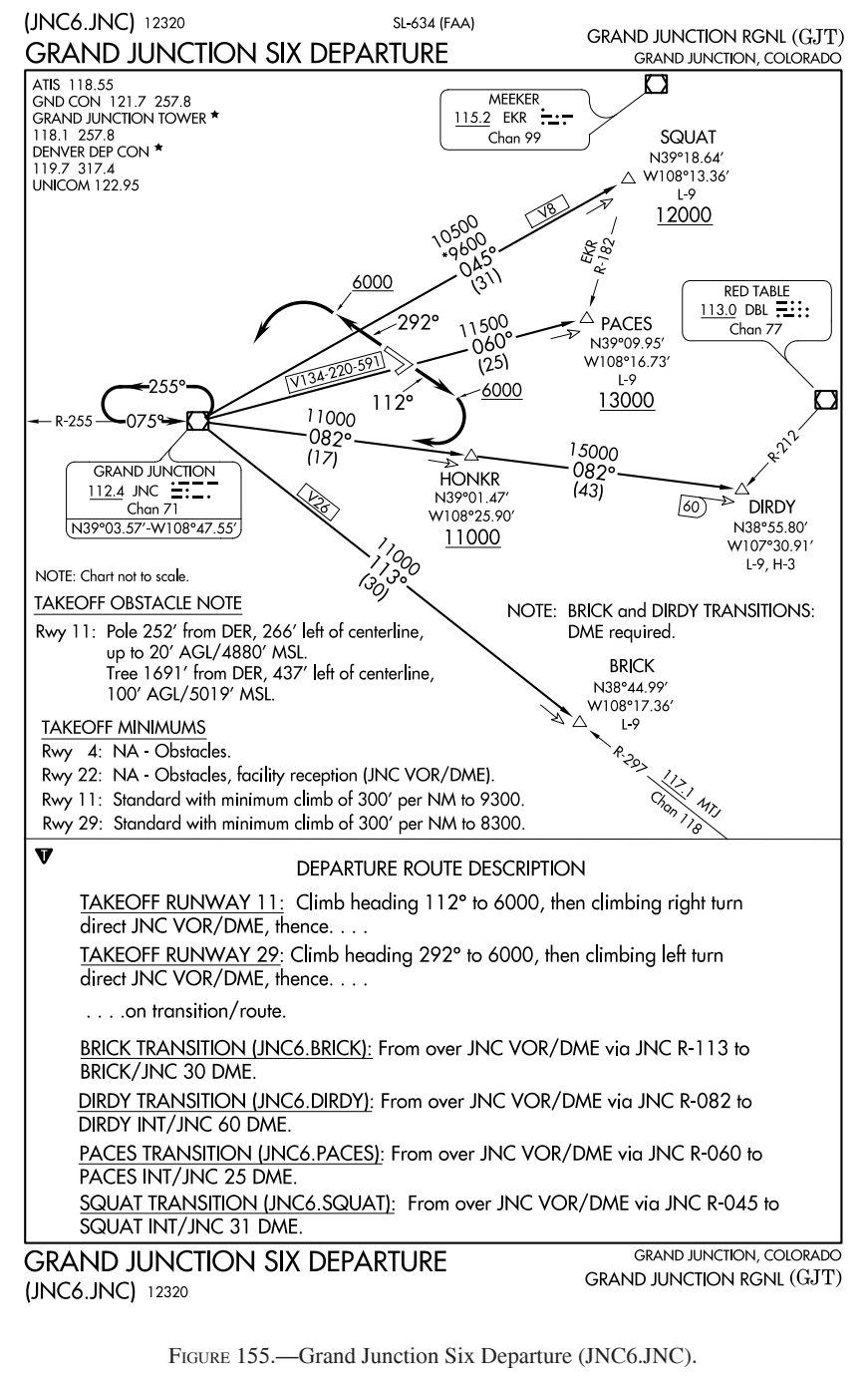
FAA-CT-8080-3F, Figure 155 (Grand Junction Six Departure (JNC6.JNC)). 2017 testing supplement; chart data is old, not for navigation. - A300 feet per minute
- B450 feet per minute
- C600 feet per minute
Show the answer and explanationHide the answer
Answer: B. 450 feet per minute
The takeoff minimums for Runway 11 call for a climb of at least 300 feet per NM to 9300 feet. At 90 knots you cover 1.5 NM each minute, so the rate needed is 300 x 1.5 = 450 feet per minute. A higher groundspeed raises the rate you need for the same gradient.
Why the others are wrong
- A: The 300 is the gradient in feet per NM, not a rate; it equals a rate only at 60 knots.
- C: 600 feet per minute is the rate for 120 knots (2 NM per minute), not 90 knots.
FAA source
- FAA-CT-8080-3F, Figure 155, p. 118
- IPH (FAA-H-8083-16B), p. 1-18
- AIM (Change 3, 9 Jul 2026), para 5-2-9
Question 4IR.I.A.K1
Your instrument currency under 14 CFR 61.57(c) ran out at the end of January 2026, and you have logged no instrument time since. It is now October 2026. You hold an instrument rating and want to fly IFR again. What must you do?
- AFly six approaches, holding, and tracking with a safety pilot
- BComplete a flight review with any flight instructor
- CPass an instrument proficiency check with an authorized person
Show the answer and explanationHide the answer
Answer: C. Pass an instrument proficiency check with an authorized person
A pilot who has not met the instrument experience requirements for more than six calendar months may regain instrument currency only by completing an instrument proficiency check. Your currency lapsed at the end of January, so by October more than six calendar months have passed. The check covers the ACS areas of operation and is given by an examiner, an authorized instructor, or another person the rule names.
Why the others are wrong
- A: Making up the tasks with a safety pilot only works within the first six calendar months after currency lapses.
- B: A flight review under 61.56 is a separate requirement and does not restore instrument currency.
FAA source
- 14 CFR 61.57(d)(1)-(3)
Question 5IR.I.A.K1
You fly approaches, holding, and course intercepting and tracking alone in an FAA-approved aviation training device that represents an airplane, with no instructor present. You want this session to count toward your 6-month instrument experience requirement. What record is required?
- AA logbook or training record showing the device, time, and content
- BAn authorized instructor's signature verifying the time and content
- CNo record helps, because device time cannot count toward recency
Show the answer and explanationHide the answer
Answer: A. A logbook or training record showing the device, time, and content
14 CFR 61.57(c)(2) lets you meet the instrument experience requirement in a full flight simulator, flight training device, or aviation training device that represents the right aircraft category. For recency, 61.51(g)(5) requires only a logbook or training record that specifies the training device, the time, and the content. The instructor observation and signature in 61.51(g)(4) applies to device time used toward a certificate or rating.
Why the others are wrong
- B: An instructor's observation and signature is needed for device time credited toward a certificate or rating, not for recency.
- C: 61.57(c)(2) allows device time for recency, alone or combined with time in an aircraft.
FAA source
- 14 CFR 61.57(c)(2)
- 14 CFR 61.51(g)(4)-(5)
Question 6IR.I.A.K1
On a 2.0-hour flight on an IFR flight plan, you are in cloud for 0.8 hour, flying solely by reference to instruments. The remaining 1.2 hours are in clear air above the layer with a visible horizon, still on your IFR clearance. How much actual instrument time may you log?
- A2.0 hours, because the whole flight was flown under IFR
- B0.8 hour, the time flown solely by instruments in cloud
- CNone, unless a safety pilot or instructor was on board
Show the answer and explanationHide the answer
Answer: B. 0.8 hour, the time flown solely by instruments in cloud
You may log instrument time only for flight time when you operate the aircraft solely by reference to instruments under actual or simulated instrument conditions. Time in clear air with a visible horizon does not qualify, even on an IFR clearance. So only the 0.8 hour in cloud counts as actual instrument time.
Why the others are wrong
- A: Being on an IFR flight plan does not by itself make flight time instrument time.
- C: A safety pilot is required for simulated instrument flight, not for flight in actual instrument conditions.
FAA source
- 14 CFR 61.51(g)(1)
- 14 CFR 91.109(c)
Question 7IR.I.A.K2
You are a private pilot with an airplane single-engine land rating but no instrument rating. The weather along your route is clear, and a friend suggests filing IFR to get the ATC services that come with it. May you act as pilot in command on an IFR flight plan?
- AYes, as long as you stay in VMC for the entire flight
- BYes, if a pilot with an instrument rating rides along
- CNo, an instrument rating is needed to act as PIC under IFR
Show the answer and explanationHide the answer
Answer: C. No, an instrument rating is needed to act as PIC under IFR
No person may act as pilot in command of a civil aircraft under IFR, or in weather below VFR minimums, without an instrument rating appropriate to the aircraft (or an ATP certificate). The rule is tied to flying under IFR, not to the weather. Clear skies do not change it.
Why the others are wrong
- A: 61.3(e) applies to any flight under IFR, whatever the weather.
- B: An instrument-rated pilot on board could act as PIC, but you still could not.
FAA source
- 14 CFR 61.3(e)
II. Preflight Procedures
14% of the real test, about 8 of the 60 questions.
Question 8IR.II.A.K1
Your airplane's flight manual describes the wing boots as a deicing system and the heated pitot tube as an anti-icing system. What does that wording tell you about how each one works?
- AThe boots remove ice that has already formed, while the heated pitot tube keeps ice from forming
- BThe boots keep ice from forming, while the heated pitot tube melts ice that has already formed
- CThe two terms mean the same thing, and manuals use them interchangeably for any ice protection
Show the answer and explanationHide the answer
Answer: A. The boots remove ice that has already formed, while the heated pitot tube keeps ice from forming
Anti-icing equipment is designed to prevent the formation of ice, while deicing equipment removes ice once it has formed. Pneumatic boots crack off accumulated ice. Electric heat on a pitot tube keeps ice from building up in the first place.
Why the others are wrong
- B: This reverses the terms: anti-icing prevents ice from forming and deicing removes ice that has accumulated.
- C: Anti-icing and deicing are different functions, and the manual's wording tells you when each system is meant to be used.
FAA source
- PHAK (FAA-H-8083-25C), p. 7-40
Question 9IR.II.A.K1
You are in IMC and ice starts to build on the wing leading edges. Your airplane has modern pneumatic deicing boots. According to the PHAK, when can you cycle the boots?
- AOnly after about a half inch of ice has built up, so the boots can crack it all off at once
- BAs soon as you see ice accumulating, because ice bridging does not occur with modern boots
- COnly after the outside air temperature falls below minus 20 degrees Celsius, when the ice turns brittle
Show the answer and explanationHide the answer
Answer: B. As soon as you see ice accumulating, because ice bridging does not occur with modern boots
The PHAK explains that early boot cycling was once thought to make the ice layer expand instead of break off (bridging). It states that bridging does not occur with any modern boots, so pilots can cycle the boots as soon as ice accumulation is observed. Always follow the AFM/POH for your airplane.
Why the others are wrong
- A: Older teaching warned about bridging, but the PHAK says it does not occur with modern boots, and waiting only lets more ice build.
- C: Boots are not limited by a temperature threshold like this, and waiting only lets more ice build.
FAA source
- PHAK (FAA-H-8083-25C), p. 7-40
Question 10IR.II.A.K1
The Instrument Flying Handbook says propeller areas where ice could be ingested into the engine are normally anti-iced rather than deiced. What is the reason?
- AAnti-icing uses less electrical power than deicing, so the generator load stays lower
- BIce on a propeller does not affect thrust, so only the engine inlet needs any protection
- CPreventing ice from forming reduces the chance of ice being shed into the engine
Show the answer and explanationHide the answer
Answer: C. Preventing ice from forming reduces the chance of ice being shed into the engine
Propeller ice reduces thrust, and the greatest accumulation is on the spinner and inner blade radius. Areas where ice could break off and enter the engine are anti-iced, which lowers the probability of ice being shed into the engine.
Why the others are wrong
- A: Power use is not the reason given; the concern is ice breaking loose and being ingested.
- B: Ice on propeller blades reduces thrust for the same reasons wings lose lift and gain drag when iced.
FAA source
- IFH (FAA-H-8083-15B), p. 4-16
Want to try it against the clock?
The free mock gives you 10 questions in the real test format, scored by test area. No signup.
Take the free mockIII. Air Traffic Control (ATC) Clearances and Procedures
7% of the real test, about 4 of the 60 questions.
Question 11IR.III.A.K1
You are departing IFR from an airport with no control tower. Your clearance ends: "Clearance void if not off by 1430. If not off by 1430, advise Center not later than 1445 of intentions." A slow passenger means you are still on the ramp at 1430. What must you do?
- ATake off as soon as you are ready, because the void time only applies to the first departure attempt.
- BTell ATC of your intentions as soon as possible, and in any case no later than 1445.
- CWait until 1500 and call for a new clearance, because the old one stays valid for 30 minutes.
Show the answer and explanationHide the answer
Answer: B. Tell ATC of your intentions as soon as possible, and in any case no later than 1445.
Once the void time passes without you being airborne, you must advise ATC of your intentions as soon as possible. ATC normally gives you a time to call by, which can be no more than 30 minutes after the void time. If you have not called within 30 minutes of the void time, you are considered overdue and search and rescue procedures start.
Why the others are wrong
- A: After the void time you no longer have authority to depart IFR on that clearance, and departing anyway leaves you without IFR separation.
- C: The 30 minutes is the most time ATC allows before you are treated as overdue. It does not extend the clearance, and waiting past 1445 would trigger search and rescue.
FAA source
- AIM (Change 3, 9 Jul 2026), para 5-2-7
Question 12IR.III.A.K1
Clearance delivery reads you your IFR clearance and adds "hold for release, expect a 25 minute departure delay." The weather at your airport is now well above VFR minimums and you would rather not wait. Which statement is correct?
- AYou may depart VFR now if you first cancel the IFR flight plan and squawk a VFR code.
- BYou may depart IFR now, because hold for release does not apply when the weather is VFR.
- CYou may depart now on your IFR code and receive the release once you are airborne.
Show the answer and explanationHide the answer
Answer: A. You may depart VFR now if you first cancel the IFR flight plan and squawk a VFR code.
Hold for release means you may not depart using that IFR clearance until ATC issues a release time or further instructions. It applies only to the IFR clearance, so it does not stop you departing VFR. Before takeoff you should cancel the IFR flight plan and set the transponder to the appropriate VFR code. You may not get an IFR clearance quickly once airborne.
Why the others are wrong
- B: The hold for release applies to the IFR clearance whatever the weather. VFR weather only lets you choose a VFR departure instead.
- C: You may not depart under the IFR clearance before the release, and a VFR departure should not use the IFR transponder code.
FAA source
- AIM (Change 3, 9 Jul 2026), para 5-2-7
IV. Flight by Reference to Instruments
11% of the real test, about 7 of the 60 questions.
Question 13IR.IV.A.K1
You are flying straight and level at a true airspeed of 120 knots and want to roll into a standard rate turn. Using the handbook rule of thumb (divide the airspeed by 10, then add half of that result), about what angle of bank is needed?
- A18 degrees
- B12 degrees
- C24 degrees
Show the answer and explanationHide the answer
Answer: A. 18 degrees
A standard rate turn is 3 degrees per second, and the bank it needs grows with true airspeed. The rule of thumb is about 15 percent of true airspeed. Here 120 divided by 10 is 12, half of 12 is 6, and 12 plus 6 gives 18 degrees. Roll in with the attitude indicator, then check the turn coordinator for the standard rate mark.
Why the others are wrong
- B: That is only the airspeed divided by 10; the half-value must be added.
- C: That doubles the airspeed divided by 10; the rule adds only half of it.
FAA source
- IFH (FAA-H-8083-15B), p. 7-19
- IFH (FAA-H-8083-15B), p. 7-20
Question 14IR.IV.A.K1
You are turning right to a heading of 270 degrees using a 14-degree bank. Using the handbook guide for roll-out lead, about how many degrees before 270 should you begin rolling out?
- A14 degrees
- B7 degrees
- C3 degrees
Show the answer and explanationHide the answer
Answer: B. 7 degrees
As long as the airplane is in a coordinated bank it keeps turning, so the roll-out must start before the heading is reached. The handbook guide is to lead the desired heading by one-half the number of degrees of bank used. Half of 14 degrees is 7 degrees, so start rolling out at about 277 degrees.
Why the others are wrong
- A: That is the whole bank angle; the guide uses only half of it.
- C: That is too little lead for a 14-degree bank, so you would roll out past the heading.
FAA source
- IFH (FAA-H-8083-15B), p. 7-20
Question 15IR.IV.A.K1
Your turn coordinator has been calibrated and shows a true standard rate turn. You plan a timed right turn from a heading of 330 degrees to a heading of 060 degrees, using the clock and equal roll-in and roll-out rates. For how long should you hold the standard rate turn?
- A60 seconds
- B15 seconds
- C30 seconds
Show the answer and explanationHide the answer
Answer: C. 30 seconds
From 330 to 060 is a 90-degree change. A standard rate turn is 3 degrees per second, so 90 divided by 3 is 30 seconds. Because the roll-in and roll-out rates are equal, the time spent rolling does not need to be added.
Why the others are wrong
- A: That is the time for a half standard rate turn through 90 degrees, not a standard rate turn.
- B: That is the time for a 45-degree change, not the 90-degree change required here.
FAA source
- IFH (FAA-H-8083-15B), p. 7-19
- IFH (FAA-H-8083-15B), p. 7-21
V. Navigation Systems
8% of the real test, about 5 of the 60 questions.
Question 16IR.V.A.K1
You are parked at an airport that has an FAA VOT and you tune its test frequency. With the CDI centered and the TO/FROM indicator showing TO, which OBS reading shows an accurate receiver?
- A000 degrees
- B090 degrees
- C180 degrees
Show the answer and explanationHide the answer
Answer: C. 180 degrees
The VOT sends a test radial that reads 0 degrees with a FROM indication or 180 degrees with a TO indication when the CDI is centered. For an IFR check under 14 CFR 91.171 the indicated bearing may be off by no more than 4 degrees when using a VOT.
Why the others are wrong
- A: 000 degrees is the correct reading only when the indicator shows FROM, not TO.
- B: The VOT does not produce a 90 degree test radial.
FAA source
- AIM (Change 3, 9 Jul 2026), para 1-1-4
- 14 CFR 91.171(b)(1)
- IFH (FAA-H-8083-15B), p. 9-16
Question 17IR.V.A.K1
Before an IFR departure you check your only VOR receiver at a certified checkpoint on the airport surface. It reads 5 degrees away from the published radial. What is the correct decision if the flight will rely on that VOR?
- ADepart IFR, because the permitted error at a ground checkpoint is 6 degrees
- BDo not depart IFR until the error is corrected, because the ground limit is 4 degrees
- CDepart IFR and apply a 5 degree correction to every bearing you fly
Show the answer and explanationHide the answer
Answer: B. Do not depart IFR until the error is corrected, because the ground limit is 4 degrees
A ground checkpoint or test signal allows a maximum error of plus or minus 4 degrees. The 6 degree limit applies only to airborne checks. Pilots may apply only the manufacturer's correction card figures, never their own correction, so the source of the error must be fixed first.
Why the others are wrong
- A: 6 degrees is the airborne checkpoint limit; the ground limit is 4 degrees.
- C: No correction other than the manufacturer's correction card may be applied during these checks.
FAA source
- 14 CFR 91.171(b)(2)
- AIM (Change 3, 9 Jul 2026), para 1-1-4
- IFH (FAA-H-8083-15B), p. 9-17
VI. Instrument Approach Procedures
26% of the real test, about 16 of the 60 questions.
Question 18IR.VI.A.K1
Flying an LNAV approach at the MDA, you see the runway lights clearly 1 NM before reaching the published visual descent point (VDP). Flight visibility meets the minimum. What does the AIM recommend?
- AStay at the MDA until the MAP, then begin the descent to land.
- BBegin descending now, since the runway lights are in sight.
- CStay at the MDA until reaching the VDP, then begin a normal descent.
Show the answer and explanationHide the answer
Answer: C. Stay at the MDA until reaching the VDP, then begin a normal descent.
The VDP is a point on a straight-in nonprecision final from which a stabilized visual descent from the MDA to the touchdown point can begin. The AIM says the pilot should not descend below the MDA before reaching the VDP. Descending past the VDP is fine when the required references are in sight, but staying level until the MAP may make a normal landing impossible.
Why the others are wrong
- A: Waiting until the MAP usually forces a steep, unstable descent; the VDP marks the normal descent point.
- B: Leaving the MDA before the VDP can put you below a safe visual path with obstacles not yet in view.
FAA source
- AIM (Change 3, 9 Jul 2026), para 5-4-5
Question 19IR.VI.E.K2
Using the figure, you are on the visual segment to a runway served by a 2-bar VASI. You see the lights as in presentation 2, with the far bar red and the near bar white. What does this show?
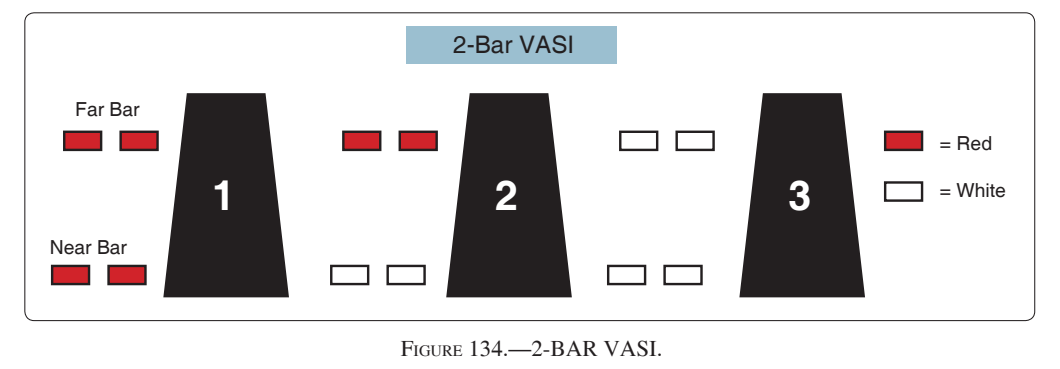
FAA-CT-8080-3F, Figure 134 (2-Bar VASI). 2017 testing supplement; chart data is old, not for navigation. - AYou are slightly above the visual glide path, which a 2-bar VASI normally sets at 3 degrees.
- BYou are on the visual glide path, which a 2-bar VASI normally sets at 3 degrees.
- CYou are on the visual glide path, which a 2-bar VASI normally sets at 2.5 degrees.
Show the answer and explanationHide the answer
Answer: B. You are on the visual glide path, which a 2-bar VASI normally sets at 3 degrees.
On a 2-bar VASI, red over white means you are on the glide path. All red means below the path and all white means above it. A 2-bar VASI provides one visual glide path that is normally set at 3 degrees, although some locations use angles as high as 4.5 degrees for obstacle clearance.
Why the others are wrong
- A: Being above the path would show both bars white, as in presentation 3.
- C: The normal setting for a 2-bar VASI is 3 degrees, not 2.5.
FAA source
- FAA-CT-8080-3F, Figure 134
- AIM (Change 3, 9 Jul 2026), para 2-1-2a, FIG 2-1-2
Question 20IR.VI.D.K1
Using the chart extract, it is night and you are flying the ILS RWY 13R approach to circle and land on Runway 31R. The weather is above the circling minimums for your category. What does the chart allow?
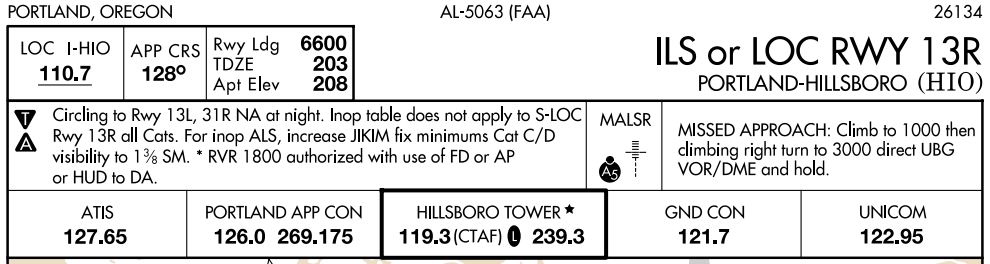
FAA approach chart (d-TPP cycle 2611, 29 Oct 2026 to 26 Nov 2026): HIO ILS OR LOC RWY 13R. Extract, not for navigation. - AThe circle to Runway 31R is allowed because the weather is above circling minimums.
- BA circle to Runway 31R is not authorized at night on this procedure.
- CThe circle to Runway 31R is allowed only in a Category A or B airplane.
Show the answer and explanationHide the answer
Answer: B. A circle to Runway 31R is not authorized at night on this procedure.
The notes box says circling to Runways 13L and 31R is NA (not authorized) at night. That restriction applies whatever the weather or approach category, so at night you must land straight in on 13R, circle to a runway that is not restricted, or plan something else. Notes in the briefing strip are part of the procedure and limit how the minimums may be used.
Why the others are wrong
- A: Weather above minimums does not lift a published restriction; the note bars this circle at night.
- C: The note names no category exception; circling to 31R is not authorized at night for every category.
FAA source
- FAA d-TPP cycle 2611, HIO ILS OR LOC RWY 13R
- Aeronautical Chart Users' Guide (9 Jul 2026), Terminal Procedures Publication, p. 102
Question 21IR.VI.A.K1
Using the chart extract, your Category B airplane has only one VOR/LOC receiver and no GPS. The glide slope has failed, so you will fly the LOC RWY 13R straight in. What MDA and visibility apply?
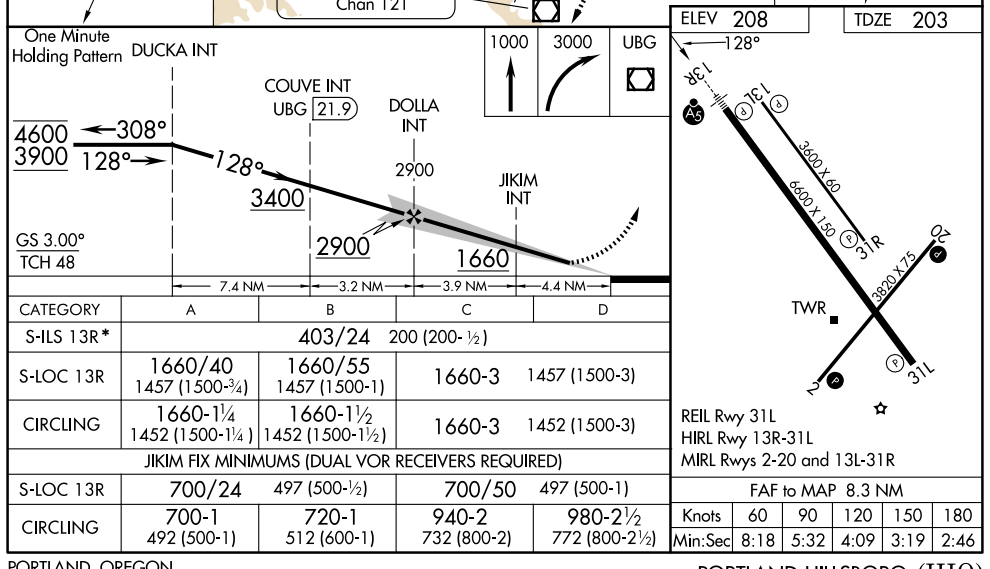
FAA approach chart (d-TPP cycle 2611, 29 Oct 2026 to 26 Nov 2026): HIO ILS OR LOC RWY 13R. Extract, not for navigation. - AMDA 700 feet MSL with RVR 2400
- BMDA 1,660 feet MSL with RVR 4000
- CMDA 1,660 feet MSL with RVR 5500
Show the answer and explanationHide the answer
Answer: C. MDA 1,660 feet MSL with RVR 5500
The lower JIKIM fix minimums need dual VOR receivers, because JIKIM is identified with a second VOR while the first stays on the localizer. With one receiver you cannot identify JIKIM, so you use the S-LOC 13R line above it. For Category B that line reads 1660/55: MDA 1,660 feet MSL and RVR 5,500 feet (RVR is charted in hundreds of feet).
Why the others are wrong
- A: 700/24 is the JIKIM fix line, which requires dual VOR receivers to identify the stepdown fix.
- B: 1660/40 is the Category A value; Category B is 1660/55, which is RVR 5500.
FAA source
- FAA d-TPP cycle 2611, HIO ILS OR LOC RWY 13R
- Aeronautical Chart Users' Guide (9 Jul 2026), Terminal Procedures Publication, p. 117
- Aeronautical Chart Users' Guide (9 Jul 2026), Terminal Procedures Publication, p. 120
Question 22IR.VI.A.K1
Your WAAS receiver is approved for LP. The RNAV (GPS) RWY 9 chart shows an LP line with an MDA of 1,060 feet MSL and an LNAV line with an MDA of 1,120 feet MSL. Which statement about the LP line is correct?
- AIt is the reduced mode the receiver falls back to if LPV integrity is lost on final.
- BIt gives lateral-only guidance that grows more sensitive near the runway and is flown to an MDA.
- CIt gives WAAS vertical guidance like an LPV and is flown to a decision altitude.
Show the answer and explanationHide the answer
Answer: B. It gives lateral-only guidance that grows more sensitive near the runway and is flown to an MDA.
LP (localizer performance) uses WAAS accuracy for lateral guidance with angular, localizer-like sensitivity that increases near the runway. It has no approved glidepath, so the LP line is a Minimum Descent Altitude. LP is published only when it gives lower minimums than LNAV and only where terrain or obstacles prevent a vertically guided procedure.
Why the others are wrong
- A: LP is not a fail-down mode for LPV. It is published only where a vertically guided procedure cannot be.
- C: LP has no approved vertical guidance; its minimum is an MDA, not a DA.
FAA source
- AIM (Change 3, 9 Jul 2026), para 5-4-5
Question 23IR.VI.A.K1
A VOR RWY 22 approach has a stepdown fix between the FAF and the MAP, identified only by DME, with a minimum altitude of 1,560 feet MSL. The straight-in MDA is 1,320 feet MSL and only one set of minimums is published. Your DME has failed. What is the lowest altitude you may descend to on final?
- A1,560 feet MSL, the stepdown fix altitude
- B1,320 feet MSL, the published MDA
- C1,420 feet MSL, the MDA plus 100 feet
Show the answer and explanationHide the answer
Answer: A. 1,560 feet MSL, the stepdown fix altitude
A stepdown fix authorizes a lower altitude once a controlling obstacle has been passed. If you cannot identify the stepdown fix, you cannot prove you have passed that obstacle, so the minimum altitude at the stepdown fix becomes your MDA. Where a chart offers a second set of minimums for pilots who cannot identify the fix, you would use those instead.
Why the others are wrong
- B: You may only use the lower MDA after positively identifying the stepdown fix, which you cannot do without DME.
- C: There is no rule adding 100 feet to the MDA; the stepdown fix altitude becomes the limit.
FAA source
- IFH (FAA-H-8083-15B), p. 1-21
- AIM (Change 3, 9 Jul 2026), para 5-4-20
VII. Emergency Operations
6% of the real test, about 4 of the 60 questions.
Question 24IR.VII.A.R1
In IMC in an airplane with an electronic flight display, the alternator fails and will not reset. The airplane now runs on battery power alone. Why is a loss of communication now a real risk, and what should you do?
- AThe battery keeps all equipment running for the rest of the flight, so continue as planned.
- BThe radios run on a separate power source, so only the flight displays are at risk of failing.
- CThe radios will fail when the batteries drain, so shed load, tell ATC and land soon.
Show the answer and explanationHide the answer
Answer: C. The radios will fail when the batteries drain, so shed load, tell ATC and land soon.
Once the charging system fails, the radios, displays and other electrical equipment run from the batteries, which may last 45 minutes or only a few minutes. Reduce the electrical load, advise ATC of the situation while you can still talk, and land as soon as practical. When the power is gone, the communication radios go with it.
Why the others are wrong
- A: A battery cannot keep everything running indefinitely. The handbook says not to rely on power after the standby battery is exhausted.
- B: The communication radio is powered from the same electrical system, so it is also at risk.
FAA source
- IFH (FAA-H-8083-15B), p. 11-6 and p. 11-7
VIII. Postflight Procedures
2% of the real test, about 1 of the 60 questions.
Question 25IR.VIII.A.K1
You fly a nonturbine small airplane with no MEL. After landing you find an inoperative DME that is not required for your next VFR day flight. What must be done before that flight under 14 CFR 91.213(d)?
- ADeactivate or remove it, placard it inoperative, and have a pilot or mechanic confirm no hazard.
- BNothing more, because equipment that is not required may simply be left in place as it was found.
- CObtain a special flight permit before the flight, because the DME cannot be repaired first.
Show the answer and explanationHide the answer
Answer: A. Deactivate or remove it, placard it inoperative, and have a pilot or mechanic confirm no hazard.
To defer under 91.213(d), the equipment must not be required by the type design, the equipment list, 91.205, or an AD. It must be deactivated or removed, placarded inoperative, and a rated pilot or mechanic must determine it is not a hazard.
Why the others are wrong
- B: Section 91.213(d) requires deactivation and a placard, not just leaving it.
- C: A special flight permit is for other cases and not required for deferral under 91.213(d).
FAA source
- 14 CFR 91.213(d)
- PHAK (FAA-H-8083-25C), ch. 9, pp. 9-9 and 9-10
Ready for the full test?
The Instrument Rating course has 641 original questions (98 with a chart extract or testing supplement figure), practice by topic and unlimited 60-question timed mocks that change every time. $39 once for 12 months, with a pass guarantee.
More free help: every topic on the test and the codes on your score report.
Questions about the Instrument Rating test
Is it the same format as the real Instrument Rating test?
Yes. Three answer choices with one correct. The full mock is 60 questions in 2 hours with a 70% pass mark, split across the eight areas of operation in the same proportions as the real test (Preflight Preparation and Instrument Approach Procedures are about a quarter each). Your results show your score in each area, like the FAA score report.
Do you have the new chart questions?
Yes. From October 26, 2026 the Instrument Rating Airplane test uses images from current IFR enroute charts and approach charts, not just the old printed supplement. Our chart questions are cropped from the current FAA charts and re-cropped automatically when the FAA publishes new ones. A question whose chart changed is held back until it has been checked again against the new chart.
Are these the real FAA test questions?
No, and you should be wary of anyone who says theirs are. Every question here is original, written from the FAA's own public publications: the regulations, the FAA handbooks and study guides, and for Part 107 the current sectional charts. That way you learn the material rather than memorizing answers, which is what the test checks.
Is this Instrument Rating practice test free?
Yes. The 25 questions on this page are free to read with their answers, and the free mock lets you take 10 questions against the clock with no signup. The full course has 641 questions, practice by topic and unlimited 60-question timed mocks for $39.
What are the ACS codes next to each question?
They are the FAA's codes for each knowledge element in the Instrument Rating Airplane test standard. Your FAA score report lists the codes for the questions you missed, so practicing by code shows you exactly what to study.
Can you give me the endorsement to take the test?
No. To take the Instrument Rating Airplane knowledge test you need a written statement or logbook endorsement from an authorized flight or ground instructor, so your instructor signs it, not us. Our course is for practicing and checking you are ready before you book.
What if I fail?
If you complete at least 90% of the question bank and still fail the FAA test, email us your FAA score report and we will refund you in full (half the package price per failed test if you bought a package). The details are on the refunds page.