 Airworthy Prep
Private Pilot practice test: 25 free questions with answers
A free Private Pilot practice test for the FAA Private Pilot Airplane knowledge test (PAR). Every question below is original, written from the FAA's own publications, and comes with the answer, an explanation, why the other options are wrong, the FAA source and the ACS code your score report would show.
The real test uses figures from the FAA testing supplement, and so do some questions here. The Navigation section also uses an extract from a current FAA sectional chart, so you practice on the charts you will fly with.
The real test: 60 questions, 2 hours, 70% to pass, three answer choices each. These 25 questions are spread across the 11 test areas in about the same proportions.
I. Preflight Preparation
22% of the real test, about 13 of the 60 questions.
Question 1PA.I.A.K1
Your logbook shows a flight review completed and endorsed on 9 November 2024. You have passed no practical test or proficiency check since then. Today is 28 October 2026. Through what date may you act as pilot in command without another flight review?
- A9 November 2026, exactly 24 months after the review
- B30 November 2026, the end of the 24th calendar month
- C30 November 2025, the end of the 12th calendar month
Show the answer and explanationHide the answer
Answer: B. 30 November 2026, the end of the 24th calendar month
You may act as pilot in command only if you have completed a flight review since the beginning of the 24th calendar month before the month in which you fly. For any flight in November 2026, the 24th calendar month before is November 2024, so the 9 November 2024 review counts for the whole of that month. From 1 December 2026 it no longer counts, so 30 November 2026 is the last day.
Why the others are wrong
- A: This counts 24 months to the day; the rule uses calendar months, which run to the end of the month.
- C: There is no 12-month flight review rule for a private pilot; the period is 24 calendar months.
FAA source
- 14 CFR 61.56(c)
Question 2PA.I.A.K1
Twenty days ago, as sole manipulator of the controls, you made three takeoffs and three touch-and-go landings in a tailwheel airplane. You have flown nothing since. Tomorrow you want to take a friend up in the same tailwheel airplane during the day. Do you meet the passenger-carrying recent experience rule?
- AYes, three takeoffs and landings in the same category and class within 90 days are enough.
- BNo, because passengers may be carried only after three night landings in the past 90 days.
- CNo, because in a tailwheel airplane the three landings must each have been to a full stop.
Show the answer and explanationHide the answer
Answer: C. No, because in a tailwheel airplane the three landings must each have been to a full stop.
To carry passengers you need three takeoffs and three landings within the preceding 90 days, as sole manipulator, in the same category, class and type (if a type rating is required). If the airplane has a tailwheel, those landings must be to a full stop in a tailwheel airplane, so touch-and-go landings do not count. You may fly alone in day VFR to make three full-stop landings first.
Why the others are wrong
- A: This ignores the extra condition that tailwheel landings must be made to a full stop.
- B: Night landings are needed only to carry passengers from 1 hour after sunset to 1 hour before sunrise.
FAA source
- 14 CFR 61.57(a)(1)
- 14 CFR 61.57(a)(2)
Question 3PA.I.A.K1
Sunset is at about 1830 every evening this week. Last week, as sole manipulator of the controls, you made three takeoffs and three full-stop landings in your airplane between 1900 and 1925. You have no other night landings in the past 90 days. Tonight you want to carry a passenger on a flight that departs at 2000 and lands at 2100. What does the night recent experience rule say?
- AYou may not: those landings came before the period that begins 1 hour after sunset.
- BYou may: full-stop landings made after sunset meet the night recent experience rule.
- CYou may, but only if the passenger holds at least a student pilot certificate.
Show the answer and explanationHide the answer
Answer: A. You may not: those landings came before the period that begins 1 hour after sunset.
To carry passengers between 1 hour after sunset and 1 hour before sunrise, you need three takeoffs and three landings to a full stop made during that same period within the preceding 90 days. With sunset at 1830, the period starts at about 1930, so landings at 1900 to 1925 do not count. Your flight at 2000 to 2100 is inside the period, so you need three qualifying night landings first.
Why the others are wrong
- B: The landings must be made from 1 hour after sunset, not merely after sunset.
- C: The rule is about the pilot's recent experience; the passenger's certificate makes no difference.
FAA source
- 14 CFR 61.57(b)(1)
Question 4PA.I.A.K1
You hold a private pilot certificate with an airplane single-engine land rating and have flown only 160-horsepower trainers. A flying club offers you an airplane with a 230-horsepower engine, fixed landing gear and a constant-speed propeller. Which logbook endorsement do you need before acting as pilot in command of it?
- AA complex airplane endorsement, because it has a controllable pitch propeller
- BA high-performance endorsement, because its engine has over 200 horsepower
- CNo endorsement, because only airplanes with retractable gear need extra training
Show the answer and explanationHide the answer
Answer: B. A high-performance endorsement, because its engine has over 200 horsepower
A high-performance airplane is one with an engine of more than 200 horsepower, and you need logged ground and flight training plus a one-time logbook endorsement from an authorized instructor before acting as its pilot in command. A complex airplane must have retractable landing gear, flaps and a controllable pitch propeller, so an airplane with fixed gear is not complex.
Why the others are wrong
- A: A controllable pitch propeller alone does not make an airplane complex; it also needs retractable gear and flaps.
- C: The 230-horsepower engine makes it high performance, which needs an endorsement whatever the gear type.
FAA source
- 14 CFR 61.31(f)(1)
- 14 CFR 61.1 (definition of complex airplane)
Question 5PA.I.A.K1
You are a private pilot who flies for fun most weekends. A friend tells you that the regulations require you to log every flight you make. What does 14 CFR 61.51(a) actually require you to record?
- AEvery flight, with the date, total time and airports of departure and arrival
- BOnly flights with passengers, because those are the ones the FAA can inspect
- COnly the time used to meet certificate, rating, flight review or recency rules
Show the answer and explanationHide the answer
Answer: C. Only the time used to meet certificate, rating, flight review or recency rules
You must document the training and aeronautical experience used to meet the requirements for a certificate, rating or flight review, and the experience used to meet the recent flight experience rules. Other flights may be logged but do not have to be. When you do log a flight for those purposes, the entry needs items such as the date, total time and departure and arrival points.
Why the others are wrong
- A: These are the contents of an entry, not a rule that every flight must be logged.
- B: Nothing in the rule depends on passengers; it depends on what the time is used to show.
FAA source
- 14 CFR 61.51(a)
- 14 CFR 61.51(b)(1)
II. Preflight Procedures
13% of the real test, about 8 of the 60 questions.
Question 6PA.II.D.K4
Refer to the figure. You are taxiing a tailwheel airplane in a strong wind, holding the stick forward and to the right. For wind from which arrow is this the recommended control position?
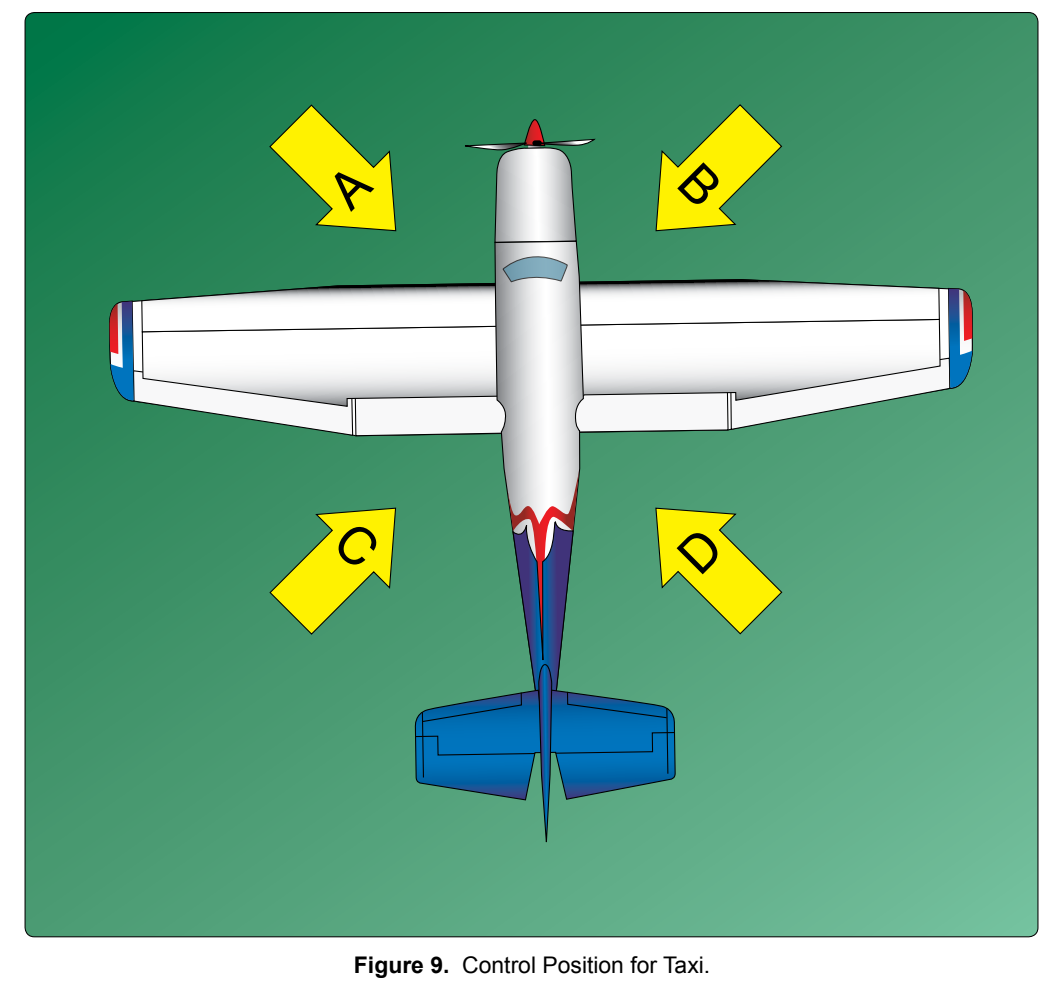
FAA-CT-8080-2H, Figure 9 (Control Position for Taxi). 2018 testing supplement; chart data is old, not for navigation. - AThe arrow labeled C, a left quartering tailwind
- BThe arrow labeled B, a right quartering headwind
- CThe arrow labeled D, a right quartering tailwind
Show the answer and explanationHide the answer
Answer: A. The arrow labeled C, a left quartering tailwind
Stick to the right lowers the left aileron. In a quartering tailwind you hold the stick away from the wind, with the upwind aileron down, so the wind is from the left rear: arrow C. Forward stick lowers the elevator, which the AFH says is essential in a strong tailwind so the wind cannot lift the tail. In a quartering headwind a tailwheel pilot holds the stick into the wind and usually full back.
Why the others are wrong
- B: A right quartering headwind calls for stick right but held back, not forward.
- C: A right quartering tailwind calls for stick forward and to the left, away from the wind.
FAA source
- FAA-CT-8080-2H, Figure 9
- AFH (FAA-H-8083-3C), p. 14-2
- AFH (FAA-H-8083-3C), p. 2-19
Question 7PA.II.A.K1
Your medical certificate is current and you feel physically well, but you spent the night worrying about a large unpaid bill and a family argument. You have a solo cross-country flight planned this morning. How does the PHAK treat this stress in the IMSAFE self-check?
- AIt is not a grounding condition in the regulations, but it can hurt your concentration and performance.
- BIt is listed in the regulations as a condition that grounds you until a medical examiner clears you.
- CIt counts only if it started within 8 hours of the flight, the same window the rules use for alcohol.
Show the answer and explanationHide the answer
Answer: A. It is not a grounding condition in the regulations, but it can hurt your concentration and performance.
The S in IMSAFE asks whether you are under psychological pressure from work, money, health or family problems. The PHAK points out that the regulations list medical conditions that require grounding, but stress is not among them. Stress still causes concentration and performance problems, so you should weigh its effect on your flying before you go.
Why the others are wrong
- B: The PHAK says stress is not among the conditions the regulations list as grounding.
- C: The 8-hour window belongs to the alcohol item; stress has no time limit and is judged on its effect.
FAA source
- PHAK (FAA-H-8083-25C), p. 2-8
Question 8PA.II.A.K1
You hold an unexpired third-class medical certificate and do not use BasicMed. Your doctor starts you on a medication for a new condition, and the treatment means you would not currently meet the third-class medical standards. May you act as pilot in command this weekend?
- AYes, because your medical certificate has not yet reached its expiration date.
- BYes, provided you fly only in day VFR conditions and carry no passengers.
- CNo, because the treatment leaves you unable to meet the medical standards.
Show the answer and explanationHide the answer
Answer: C. No, because the treatment leaves you unable to meet the medical standards.
Under 14 CFR 61.53(a), a person who holds a medical certificate may not act as pilot in command while taking medication or receiving treatment for a medical condition that leaves the person unable to meet the standards for the required medical certificate. An unexpired certificate does not override this. You are grounded until you again meet the standards.
Why the others are wrong
- A: The expiration date does not matter; 61.53 applies whenever you know you no longer meet the standards.
- B: The rule has no exception for day VFR or solo flights; you may not act as pilot in command at all.
FAA source
- 14 CFR 61.53(a)(2)
Want to try it against the clock?
The free mock gives you 10 questions in the real test format, scored by test area. No signup.
Take the free mockIII. Airport and Seaplane Base Operations
7% of the real test, about 4 of the 60 questions.
Question 9PA.III.B.K2
Using the figure, you are on final to a runway with a standard 2-bar VASI, and the lights look like illustration C. What does this show, and what should you do?
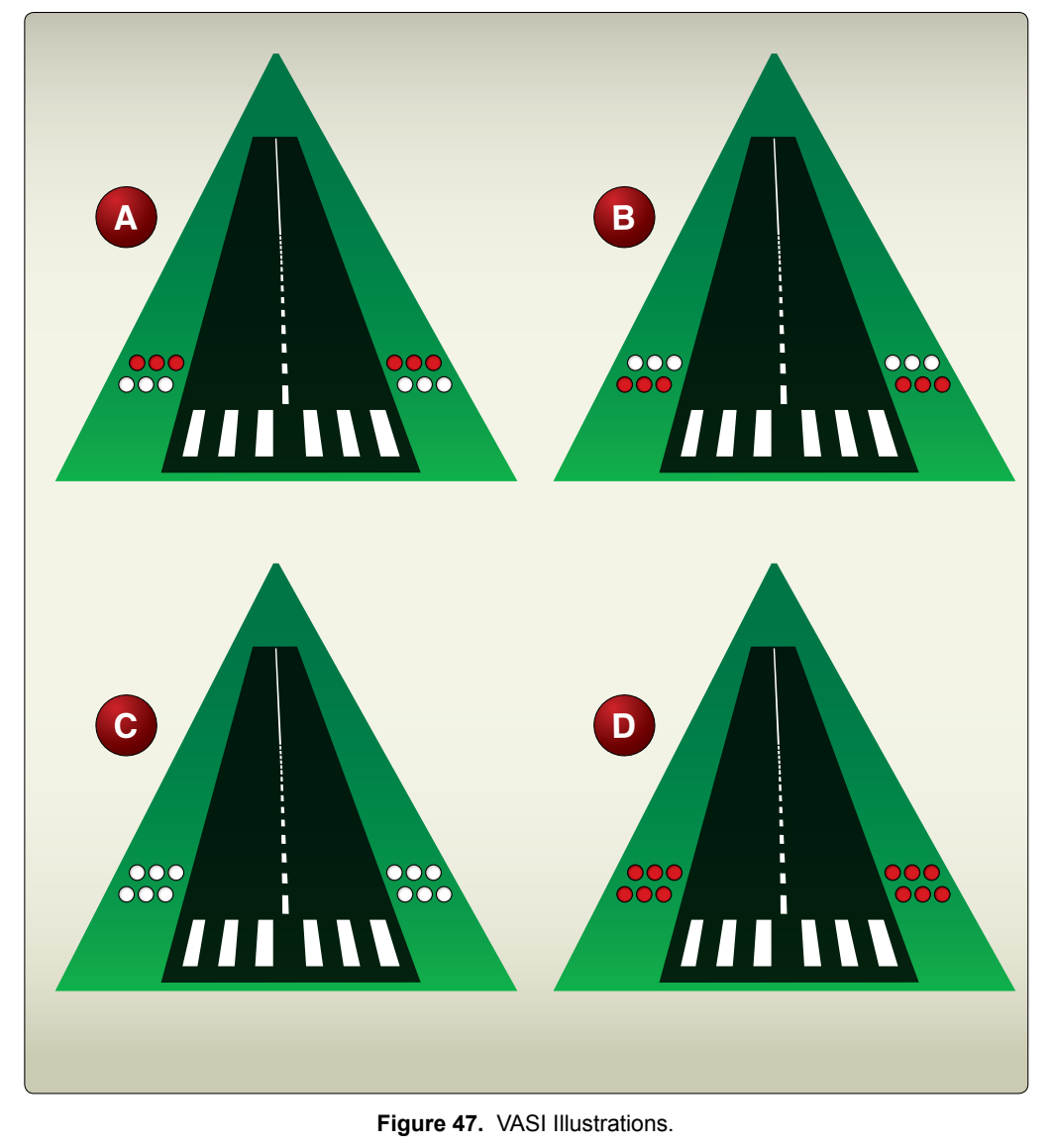
FAA-CT-8080-2H, Figure 47 (VASI Illustrations). 2018 testing supplement; chart data is old, not for navigation. - AOn the glide path; hold your present descent rate.
- BBelow the glide path; level off until a bar turns white.
- CAbove the glide path; steepen your descent to rejoin it.
Show the answer and explanationHide the answer
Answer: C. Above the glide path; steepen your descent to rejoin it.
Each VASI light shows white in the upper part of its beam and red in the lower part. In illustration C both the near and far bars are white, which means you are above the glide path. On the glide path the far bar shows red and the near bar white; below it both bars show red.
Why the others are wrong
- A: On the glide path the far (upper) bar would be red over a white near bar, as in illustration A.
- B: Below the glide path both bars would be red, as in illustration D.
FAA source
- FAA-CT-8080-2H, Figure 47
- AIM (Change 3, 9 Jul 2026), para 2-1-2
- PHAK (FAA-H-8083-25C), p. 14-16
Question 10PA.III.A.K1
You decide in flight to divert to a small nontowered airport, but your tablet has died and you have no Chart Supplement on board. According to the AIM, how can you get that airport's CTAF?
- ACall any flight service station and ask for it.
- BUse 122.9, the CTAF at every nontowered airport.
- CListen to the nearest ATIS, which always lists it.
Show the answer and explanationHide the answer
Answer: A. Call any flight service station and ask for it.
The AIM lists the Chart Supplement, instrument approach charts and departure procedure charts as sources of the CTAF, and adds that the CTAF can also be obtained by contacting any FSS. With no publications available, a call to flight service gets you the correct frequency.
Why the others are wrong
- B: 122.9 (MULTICOM) is used only where there is no tower, FSS or UNICOM; many airports use a UNICOM or tower frequency as the CTAF.
- C: An ATIS is a recording for one busy airport; it does not list the CTAF of other airports.
FAA source
- AIM (Change 3, 9 Jul 2026), para 4-1-9
IV. Takeoffs, Landings, and Go-Arounds
20% of the real test, about 12 of the 60 questions.
Question 11PA.IV.D.K1
What is the main difference between a normal approach and a soft-field approach and landing in how the pilot manages power?
- AA degree of power is kept through the level-off and touchdown, letting the airspeed bleed off slowly just above the surface.
- BPower is closed earlier on final, so the airplane arrives at the field slower and touches down sooner on the main wheels.
- CFull power is added in the flare, so the airplane can climb away again at once if the surface turns out to be too soft.
Show the answer and explanationHide the answer
Answer: A. A degree of power is kept through the level-off and touchdown, letting the airspeed bleed off slowly just above the surface.
The soft-field approach is similar to a normal approach. The major difference is that a degree of power is used throughout the level-off and touchdown. This lets the airspeed dissipate slowly while the airplane is flown 1 to 2 feet above the surface in ground effect, so the wings still carry much of the weight when the wheels first touch.
Why the others are wrong
- B: Closing the power early leads to a hard, high-sink touchdown, the opposite of the soft-field aim.
- C: Full power in the flare would cause floating or a climb; the technique uses a small amount of power.
FAA source
- AFH (FAA-H-8083-3C), p. 9-23
Question 12PA.IV.A.K1
The wind is from 300 degrees at 12 knots. You can depart on Runway 30 or Runway 12, both long and free of obstacles. Why does the AFH favor a takeoff on Runway 30?
- AThe tailwind on Runway 12 would help the airplane reach rotation speed sooner.
- BThe headwind supplies some airspeed at the start, so less groundspeed is needed.
- CThe headwind lets the airplane lift off at a lower indicated airspeed than usual.
Show the answer and explanationHide the answer
Answer: B. The headwind supplies some airspeed at the start, so less groundspeed is needed.
The airplane flies on airspeed, and a headwind provides some of that airspeed before the takeoff roll even begins. It also lowers the groundspeed needed to reach flying speed, which shortens the ground roll and reduces wear on the landing gear. Runway 30 points straight into the wind.
Why the others are wrong
- A: A tailwind makes the airplane reach a higher groundspeed before it has lift-off airspeed, so the roll gets longer, not shorter.
- C: The lift-off indicated airspeed does not change with wind; only the groundspeed needed to reach it changes.
FAA source
- AFH (FAA-H-8083-3C), p. 6-3
- PHAK (FAA-H-8083-25C), p. 11-15
Question 13PA.IV.A.K1
You plan a 2 p.m. departure on a hot summer day from an airport 6,500 feet above sea level. Compared with a cool morning at a sea level airport, what should you expect?
- AA shorter takeoff roll, since the thinner air means less drag during the roll.
- BThe same takeoff roll, but a higher climb pitch to hold the normal climb speed.
- CA longer takeoff roll and weaker climb, flown at a lower climb pitch attitude.
Show the answer and explanationHide the answer
Answer: C. A longer takeoff roll and weaker climb, flown at a lower climb pitch attitude.
High density altitude reduces engine and propeller performance, increases the takeoff roll and decreases climb performance. Because power is limited, the pitch attitude that holds the climb speed is lower than at sea level. Check the performance charts before deciding the takeoff is safe.
Why the others are wrong
- A: Thin air reduces engine and propeller output and needs a higher true airspeed to fly, so the roll gets longer.
- B: With less power available the climb pitch is lower, not higher, and the takeoff roll increases.
FAA source
- AFH (FAA-H-8083-3C), p. 6-1
- AFH (FAA-H-8083-3C), p. 6-5
Question 14PA.IV.A.K2
A row of tall trees stands a short distance past the departure end of your runway. Once airborne, which airspeed gives the greatest gain in altitude for the distance covered over the ground?
- AVX, the best angle of climb speed
- BVY, the best rate of climb speed
- CA cruise climb speed above VY
Show the answer and explanationHide the answer
Answer: A. VX, the best angle of climb speed
VX is the speed that gives the greatest gain in altitude for a given distance over the ground, so it is the speed for clearing an obstacle close to the runway. VY gives the greatest gain in altitude per unit of time. VX is usually slightly lower than VY.
Why the others are wrong
- B: VY gives the most altitude per minute, not per foot of ground covered, so the climb angle is shallower than at VX.
- C: A cruise climb is flatter still, trading climb angle for speed and visibility.
FAA source
- AFH (FAA-H-8083-3C), p. 6-10
Question 15PA.IV.A.K2
After a normal takeoff with no obstacles, you hold takeoff power and climb at VY to at least 500 feet above the surrounding terrain. According to the AFH, what is the safety benefit of this?
- AIt gives the steepest climb angle, so you leave the runway area soonest.
- BIt gains the most altitude in the least time, leaving height for an emergency.
- CIt uses a lower pitch, so a power failure needs a slower pilot reaction.
Show the answer and explanationHide the answer
Answer: B. It gains the most altitude in the least time, leaving height for an emergency.
VY with takeoff power gives the maximum altitude gain in the minimum time. That extra height gives the pilot more room to maneuver safely if the engine fails or another emergency occurs. The AFH recommends keeping takeoff power until at least 500 feet above the surrounding terrain or obstacles.
Why the others are wrong
- A: The steepest climb angle comes from VX, not VY.
- C: The AFH says the opposite: flying at VY needs a quick reaction to a power failure to avoid a stall, which is why a lower-pitch cruise climb is worth considering later.
FAA source
- AFH (FAA-H-8083-3C), p. 6-5
V. Performance Maneuvers and Ground Reference Maneuvers
3% of the real test, about 2 of the 60 questions.
Question 16PA.V.A.K1
You start a steep turn to the left on a heading of 180 degrees, using 50 degrees of bank, and plan to roll out on 180. Using the AFH rule of thumb for leading the rollout, at about what heading should you begin rolling out?
- A205 degrees
- B155 degrees
- C230 degrees
Show the answer and explanationHide the answer
Answer: A. 205 degrees
The AFH rule of thumb is to begin the rollout at one half the bank angle before the terminating heading. Half of 50 degrees is 25 degrees. In a left turn the heading numbers decrease, so you reach 180 coming from the higher numbers: 180 + 25 = 205 degrees.
Why the others are wrong
- B: 155 degrees applies the lead in the wrong direction; in a left turn you pass 155 only after you have already gone through 180.
- C: 230 degrees uses the full 50 degrees of bank as the lead instead of half of it.
FAA source
- AFH (FAA-H-8083-3C), p. 10-3
VI. Navigation
8% of the real test, about 5 of the 60 questions.
Question 17PA.VI.B.K3
You are receiving VFR radar traffic advisories from approach control and now want to leave the frequency to listen to an airport's CTAF. What is the correct procedure?
- ASet the transponder to 1200 and change frequency; the controller will see the code change.
- BTell the controller you no longer want advisories before changing frequency, then set 1200 if applicable.
- CChange frequency without calling; radar service ends automatically when you stop talking.
Show the answer and explanationHide the answer
Answer: B. Tell the controller you no longer want advisories before changing frequency, then set 1200 if applicable.
While receiving VFR radar advisory service you should monitor the assigned frequency at all times, so the controller does not suspect a radio failure or an emergency. When you no longer want the service, advise the controller before changing frequencies, and then change your transponder code to 1200 if applicable.
Why the others are wrong
- A: A code change is not a substitute for telling the controller; they may think you have a problem.
- C: Leaving without a call can make the controller suspect radio failure or an emergency.
FAA source
- AIM (Change 3, 9 Jul 2026), para 4-1-15
Question 18PA.VI.B.K3
Refer to the chart extract. You are inbound VFR to land at Richmond Intl (RIC). Two-way radio communication and radar contact are now established with approach control inside the Class C airspace. What service do you receive?
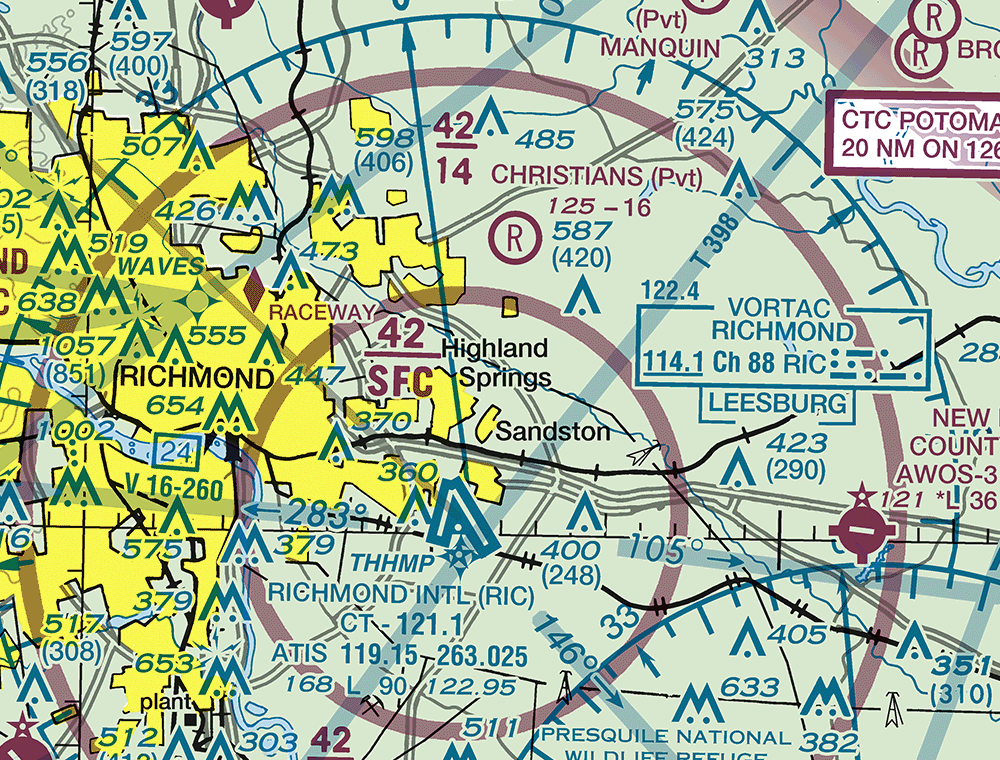
Washington Sectional, 29 Oct 2026 to 24 Dec 2026 (FAA). Extract, not for navigation. - ASeparation from all other VFR aircraft, so traffic scanning is no longer your job.
- BTraffic advisories only, with sequencing to the runway starting once you call the tower.
- CSequencing to RIC and separation from IFR aircraft within the Class C airspace.
Show the answer and explanationHide the answer
Answer: C. Sequencing to RIC and separation from IFR aircraft within the Class C airspace.
Once two-way radio communication and radar contact are established in Class C, VFR aircraft are sequenced to the primary airport and separated from IFR aircraft (by visual separation, 500 feet vertically or target resolution). The service does not relieve you of seeing and avoiding other traffic, and VFR aircraft are not separated from each other.
Why the others are wrong
- A: VFR aircraft are separated from IFR aircraft, not from other VFR aircraft, and see and avoid still applies.
- B: Approach control sequences VFR arrivals to the primary airport as part of Class C service, before the tower handoff.
FAA source
- AIM (Change 3, 9 Jul 2026), para 3-2-4d
- AIM (Change 3, 9 Jul 2026), para 3-2-4e
- AIM (Change 3, 9 Jul 2026), para 3-2-4f4
- Chart Users' Guide (9 Jul 2026), p. 16
VII. Slow Flight and Stalls
8% of the real test, about 5 of the 60 questions.
Question 19PA.VII.B.R5
You recover from a stall at low altitude and, seeing the ground close below, pull the nose up sharply. The airplane shudders and stalls again. What caused the second stall?
- AThe abrupt pull-up exceeded the critical AOA a second time.
- BThe throttle was at idle, so the wing could not keep flying.
- CThe airspeed was too high, which always makes the wing stall.
Show the answer and explanationHide the answer
Answer: A. The abrupt pull-up exceeded the critical AOA a second time.
This is a secondary stall, one that occurs after recovery from a preceding stall. Near the ground the natural impulse is to bring the nose up abruptly, which takes the wing past the critical angle of attack again. It can also happen if the pilot does not lower the pitch enough or tries to break the stall with power only.
Why the others are wrong
- B: A stall is caused by angle of attack, and power alone cannot prevent or break it.
- C: High speed alone does not stall a wing; the abrupt pull raised the angle of attack.
FAA source
- AFH (FAA-H-8083-3C), p. 5-18
- PHAK (FAA-H-8083-25C), p. 5-36
Question 20PA.VII.A.K1
You are established in straight-and-level slow flight in the landing configuration, holding altitude a few knots above the stall warning. You now want to start a gentle straight-ahead climb while keeping the same airspeed. What should you do?
- AAdd power, and make small pitch changes to hold the airspeed.
- BRaise the nose without adding power, since pitch sets the path.
- CRaise the flaps to cut drag, then raise the nose slightly.
Show the answer and explanationHide the answer
Answer: A. Add power, and make small pitch changes to hold the airspeed.
Slow flight is flown well below L/D max, on the back side of the power curve. There, pitch is the more effective control of airspeed and power is the effective control of the flight path, so climbs and descents in slow flight are made by adjusting power. Small pitch changes then hold the target airspeed.
Why the others are wrong
- B: Below L/D max, pitch mainly controls airspeed; raising the nose without power would bleed off speed toward a stall.
- C: Raising the flaps in slow flight reduces lift and, done abruptly, can cause a stall.
FAA source
- AFH (FAA-H-8083-3C), p. 5-10
- AFH (FAA-H-8083-3C), p. 5-11
VIII. Basic Instrument Maneuvers
7% of the real test, about 4 of the 60 questions.
Question 21PA.VIII.D.R8
Flying straight and level by instruments, you keep correcting a slow turn to the left. Each time you level the wings, the left wing slowly drops again. What does the IFH identify as the likely mistake?
- AIgnoring trim: the airplane is out of trim with a left-wing-low tendency.
- BPrecession: the heading indicator is drifting, so the airplane is not really turning.
- CUsing too little bank: each correction needs about 20 degrees of bank to hold.
Show the answer and explanationHide the answer
Answer: A. Ignoring trim: the airplane is out of trim with a left-wing-low tendency.
The IFH lists failure to note the cause of a previous heading error, and so repeating it, as a common heading error. Its example is an airplane out of trim with a left-wing-low tendency, where the pilot keeps correcting for a slight left turn but ignores the trim. Fixing the trim removes the cause instead of chasing the result.
Why the others are wrong
- B: The wing visibly drops each time, which is a real bank and turn, not an instrument drift.
- C: The IFH warns against correcting with too much bank; the repeated drift points to trim.
FAA source
- IFH (FAA-H-8083-15B), p. 7-13
Question 22PA.VIII.A.K1a
In level cruise, ice blocks your static ports and you select the alternate static source, which takes its pressure from inside the cabin. What should you expect from the pitot-static instruments once the alternate source is in use?
- AThe altimeter reads slightly high, the airspeed reads high, and the VSI shows a brief climb.
- BThe altimeter reads slightly low, the airspeed reads low, and the VSI shows a brief descent.
- CThe altimeter and airspeed read correctly, and only the VSI shows a brief climb.
Show the answer and explanationHide the answer
Answer: A. The altimeter reads slightly high, the airspeed reads high, and the VSI shows a brief climb.
Because of the venturi effect of air flowing around the fuselage, the pressure inside the cabin is lower than the outside static pressure. With the alternate static source in use, the altimeter indicates slightly higher than actual, the airspeed indicator shows more than the actual airspeed, and the VSI shows a momentary climb before it settles if you hold altitude. The POH or AFM gives the size of the error for your airplane.
Why the others are wrong
- B: Cabin pressure is lower than outside pressure, so the errors go the other way: high readings and a momentary climb.
- C: The lower cabin pressure also makes the altimeter and airspeed indicator read higher than actual.
FAA source
- PHAK (FAA-H-8083-25C), p. 8-3
IX. Emergency Operations
7% of the real test, about 4 of the 60 questions.
Question 23PA.IX.B.R4
In a forced landing you are on base to a field, and you judge that you will only just reach it. When should you extend full flaps?
- ARight after the engine fails, so the airplane is set up early for landing
- BNever, since flaps add drag and always make a forced landing more risky
- COnce it is clear you will make the field, since early flaps cut the glide
Show the answer and explanationHide the answer
Answer: C. Once it is clear you will make the field, since early flaps cut the glide
Flaps improve slow-speed maneuverability and lower the stall speed, so the AFH recommends them on final when circumstances permit. But they add drag and reduce gliding distance, so premature use may ruin an otherwise sound plan. Full flaps should be delayed until it is clear they will not cause you to land short.
Why the others are wrong
- A: Extending flaps early adds drag and shortens the glide before you know you can reach the field.
- B: The AFH recommends flaps on final when time and circumstances permit, because they allow a slower touchdown.
FAA source
- AFH (FAA-H-8083-3C), p. 18-4
- AFH (FAA-H-8083-3C), p. 9-26
XI. Night Operations
3% of the real test, about 2 of the 60 questions.
Question 24PA.XI.A.K1
On a moonless night with the flight deck lights dimmed, you can pick out a dark hangar and a parked fuel truck at the edge of your view, but you cannot tell their colors or read the lettering on them. Why?
- AThe cones do most of the work at night, and they cannot see fine detail.
- BThe pupils shrink in darkness, so less light reaches the back of the eye.
- CThe rods do most of the work at night, and they cannot see color or detail.
Show the answer and explanationHide the answer
Answer: C. The rods do most of the work at night, and they cannot see color or detail.
In very low light, vision depends almost entirely on the rods, which lie mainly in the periphery of the retina. Rods detect objects and movement in shades of gray but cannot perceive color or fine detail. The cones, which handle color and detail, need brighter light to work well.
Why the others are wrong
- A: The cones are the receptors for color and detail, and they lose most of their sensitivity at night.
- B: The pupils dilate in darkness to let in more light; they do not shrink.
FAA source
- AFH (FAA-H-8083-3C), p. 11-1
- AFH (FAA-H-8083-3C), p. 11-2
XII. Postflight Procedures
2% of the real test, about 1 of the 60 questions.
Question 25PA.XII.A.R1
You land after a long day of flying. Friends are waiting on the ramp, your passengers are chatting, and someone suggests you shut down quickly and tie the airplane down later. What is the safest response?
- AShut down from memory to save time, then tie down after you greet everyone.
- BUse the shutdown checklist and secure the airplane before you treat the flight as over.
- CLeave the airplane untied for now, since the wind is calm and you will be back soon.
Show the answer and explanationHide the answer
Answer: B. Use the shutdown checklist and secure the airplane before you treat the flight as over.
The AFH says a flight is not complete until the engine is shut down and the airplane is secured, and that situational awareness ends only when the airplane is safely back at its tie-down or hangar. Distractions at the end of a flight make skipped items more likely, so using the shutdown checklist matters most then. Tie-downs, control locks and covers should be in place before you walk away.
Why the others are wrong
- A: Working from memory while distracted is how checklist items get missed.
- C: Wind can change, and the AFH counts securing the airplane as part of the flight.
FAA source
- AFH (FAA-H-8083-3C), p. 2-23
- AFH (FAA-H-8083-3C), p. 2-1
Ready for the full test?
The Private Pilot course has 612 original questions (70 with a chart extract or testing supplement figure), practice by topic and unlimited 60-question timed mocks that change every time. $29 once for 12 months, with a pass guarantee.
More free help: every topic on the test and the codes on your score report.
Questions about the Private Pilot test
Is it the same format as the real Private Pilot test?
Yes. Three answer choices with one correct. The full mock is 60 questions in 2 hours with a 70% pass mark, split across the eleven areas of operation in the same proportions as the real test (Preflight Preparation and Takeoffs, Landings, and Go-Arounds are about a fifth each). Your results show your score in each area.
Do you have sectional chart questions?
Yes. Some use figures from the FAA testing supplement, the book of charts and figures the real Private Pilot test uses. Others are extracts from current FAA sectional charts, so you also practice on the charts you will fly with. The sectional extracts are re-cropped when the FAA publishes new editions.
Are these the real FAA test questions?
No, and you should be wary of anyone who says theirs are. Every question here is original, written from the FAA's own public publications: the regulations, the FAA handbooks and study guides, and for Part 107 the current sectional charts. That way you learn the material rather than memorizing answers, which is what the test checks.
Is this Private Pilot practice test free?
Yes. The 25 questions on this page are free to read with their answers, and the free mock lets you take 10 questions against the clock with no signup. The full course has 612 questions, practice by topic and unlimited 60-question timed mocks for $29.
What are the ACS codes next to each question?
They are the FAA's codes for each knowledge element in the Private Pilot Airplane test standard. Your FAA score report lists the codes for the questions you missed, so practicing by code shows you exactly what to study.
Can you give me the endorsement to take the test?
No. To take the Private Pilot Airplane knowledge test you need an endorsement from an authorized flight or ground instructor saying you have done the ground training or a home-study course, so your instructor signs it, not us. Our course is for practicing and checking you are ready before you book.
What if I fail?
If you complete at least 90% of the question bank and still fail the FAA test, email us your FAA score report and we will refund you in full (half the package price per failed test if you bought a package). The details are on the refunds page.